Long Bien Bridge is one of Hanoi’s most historic and recognizable landmarks. Spanning the Red River since the early 20th century, the bridge has played an important role in the city’s transportation network while witnessing many key moments in Vietnam’s modern history.
Today, it remains a fascinating destination for visitors interested in Hanoi’s heritage. With its distinctive steel structure, active railway line, and wide river views, Long Bien Bridge offers a unique blend of history, architecture, and everyday local life. In this guide, Your Vietnam Travel explores the bridge’s historical background, engineering design, and what travelers can expect when visiting this iconic site.
Located just east of Hanoi’s Old Quarter, Long Bien Bridge stretches across the Red River and connects the city center with the Long Bien district. Built during the French colonial period, the bridge remains one of the oldest river crossings in Hanoi.
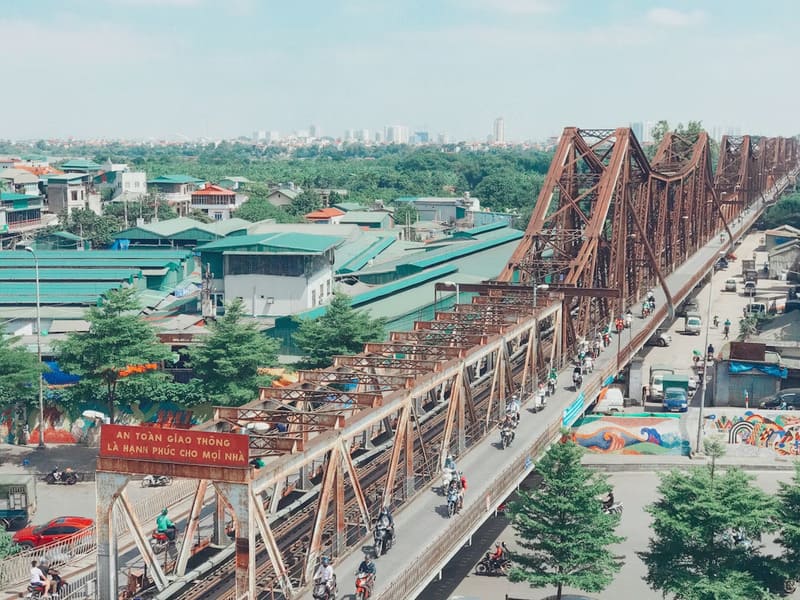
Its structure features a central railway track with narrow lanes for motorbikes, bicycles, and pedestrians on both sides. This mixed-use design creates a lively scene where trains pass through while local traffic continues across the bridge.
Beyond its transport function, Long Bien Bridge has become a cultural landmark. From the walkway, visitors can enjoy open views of the Red River, river islands, and the surrounding neighborhoods while experiencing a quieter side of Hanoi’s daily life.
Long Bien Bridge was built during the French colonial period at the end of the 19th century. Construction began in 1899 and was completed in 1902, making it one of the most significant engineering projects in Indochina at the time.
Originally named Paul Doumer Bridge, after the Governor-General of French Indochina, the structure played a crucial role in connecting Hanoi with the important port city of Hai Phong. This railway connection strengthened trade routes and military logistics across northern Vietnam.
Throughout the 20th century, the bridge became closely linked to major historical events in Vietnam. During the First Indochina War and later the Vietnam War, Long Bien Bridge was repeatedly targeted because of its strategic importance.
One of the most intense periods occurred during the American bombing campaigns in the late 1960s and early 1970s. Several sections of the bridge were severely damaged, with spans collapsing into the river. Despite these attacks, emergency repairs allowed trains and traffic to continue crossing the river.
After the war, reconstruction efforts restored many damaged sections, although not always with identical materials. As a result, the bridge today displays a mix of original steel structures and later repairs, giving it a patchwork appearance that reflects its long and turbulent history.
Following Vietnam’s independence in 1954, the bridge was officially renamed Long Bien Bridge, after the district located near its northern end.
Over time, new bridges such as Chuong Duong Bridge and Nhat Tan Bridge reduced its role in major traffic routes. However, Long Bien Bridge remains an enduring symbol of Hanoi’s resilience and historical identity.
 |
|
View of Long Bien Bridge in 2021 (Source: Unsplash) |
Long Bien Bridge is a classic example of steel truss bridge engineering, a design widely used during the industrial era for long river crossings.
The bridge was designed by Daydé & Pillé, a French engineering company based in Paris. While some sources mistakenly attribute it to Gustave Eiffel’s firm, historical records confirm that Daydé & Pillé was responsible for its construction.
When completed in the early 20th century, the bridge was among the longest structures of its kind in Asia, stretching approximately 1.6 kilometers across the Red River.
One of the most distinctive features of Long Bien Bridge is its mixed-use layout:
This unusual arrangement creates a dynamic and lively environment where trains pass through while local traffic continues moving along the side paths.
Architecturally, the bridge is recognizable by its repeating steel lattice structure, riveted joints, and slightly curved truss segments that form a silhouette often compared to the shape of a dragon’s back.
Photographers particularly appreciate the bridge during sunrise and sunset, when the warm light highlights the rusty steel beams and the river landscape below.
Beyond its historical and architectural value, Long Bien Bridge also offers a fascinating perspective of everyday life in Hanoi.
From the bridge, visitors can observe:
Walking across parts of the bridge allows travelers to experience a slower, more authentic side of the city that contrasts with the busy streets of the Old Quarter nearby.
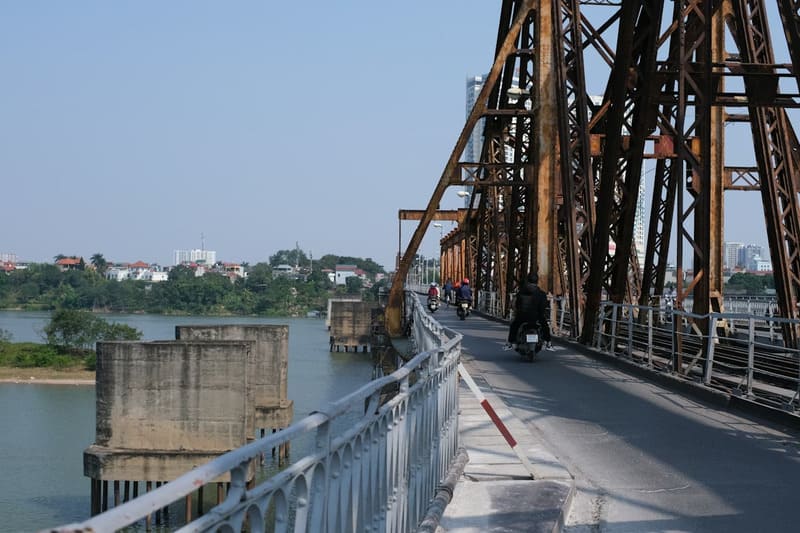
Walking along Long Bien Bridge is one of the best ways to appreciate its historical character and river views. The pedestrian lane allows visitors to observe the bridge’s steel trusses, riveted joints, and sections that have been repaired over decades.
From the walkway, you can see small boats navigating the Red River, green banana plantations on the river islands, and the changing skyline of Hanoi in the distance. The atmosphere is generally calmer on weekday mornings and late afternoons.
Note: Long Bien Bridge is still in active use. Motorbikes share the side lanes, and trains run along the central track, so visitors should stay aware of traffic while walking.
 |
|
Sidewalk at Long Bien Bridge, Hanoi (Source: Unsplash) |
The bridge is a favorite location for photographers thanks to its distinctive steel framework and repeating truss patterns. The central railway track creates strong leading lines that draw the eye toward the horizon.
Early morning and late afternoon provide the most beautiful lighting conditions. During these times, the warm sunlight highlights the aged steel beams while reflections shimmer on the Red River below.
When taking photos near the tracks, always remain on the pedestrian walkway and keep a safe distance from the railway.
 |
|
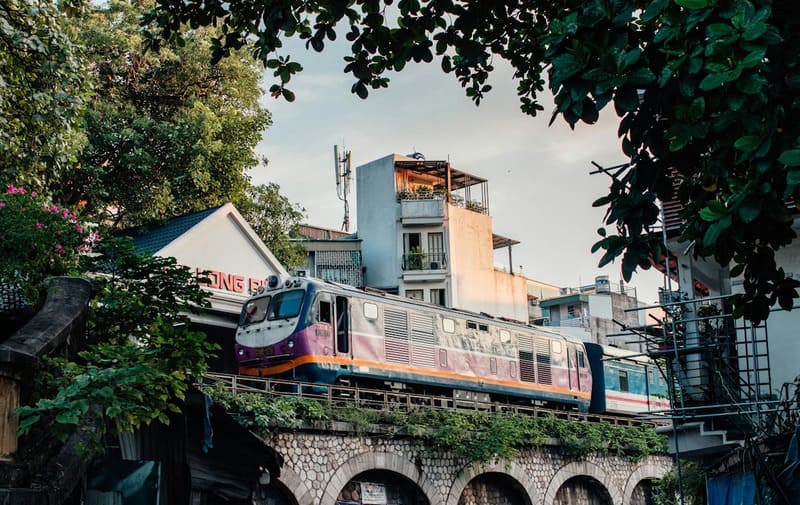
Train going from Long Bien Station, heading to Long Bien Bridge (Source: Unsplash) |
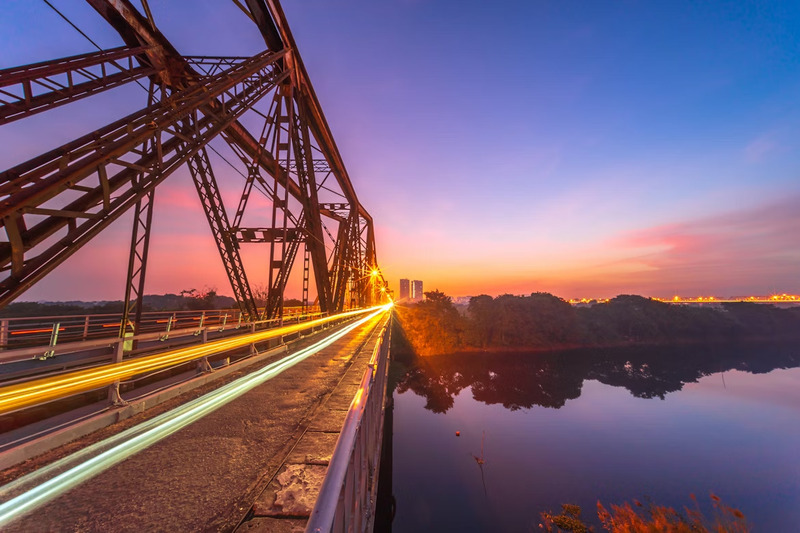
Long Bien Bridge is widely considered one of the best places in Hanoi to watch the sunrise or sunset.
In the early morning, soft mist often rises above the river, creating a peaceful scene as the city gradually wakes up. In the evening, golden light warms the steel structure and reflects across the water, offering excellent opportunities for landscape photography.
Both moments reveal a quieter side of Hanoi that contrasts with the busy streets of the nearby Old Quarter.
 |
|
Long Bien Bridge view at sunset (Source: Unsplash) |
Around the bridge entrances, especially in the evening, small vendors often sell simple Hanoi street snacks such as grilled corn and roasted sweet potatoes.
These warm snacks are popular among locals and visitors alike, particularly during cooler evenings. Enjoying them while watching the river or the passing trains adds a nostalgic touch to the experience.
Travel tip: Bring small cash, as most street vendors accept only cash payments.
Although this is only a small taste of the capital’s food culture, it pairs well with a broader local food experience in Hanoi’s backstreets and night-time neighborhoods.
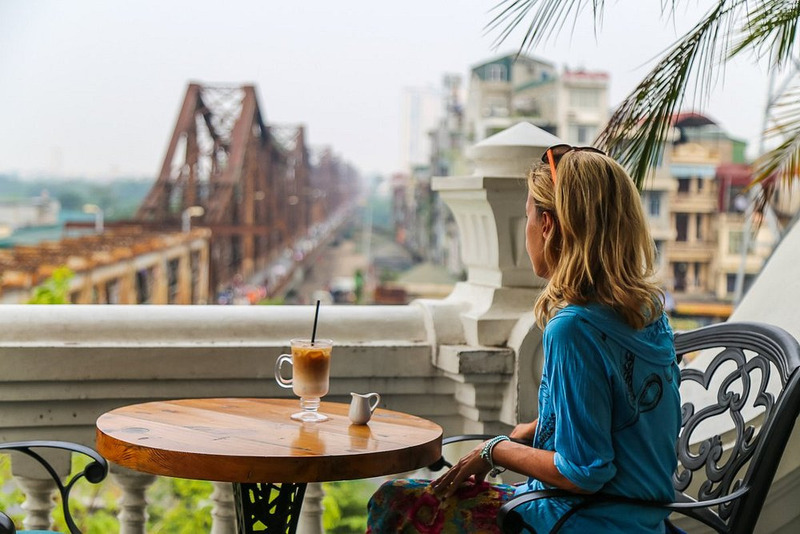
Several cafés near Long Bien Bridge offer excellent views of the historic structure. These spots are perfect for relaxing with a cup of Vietnamese coffee while observing trains crossing the bridge.
Serein Café & Lounge:
Located beside Long Bien Railway Station, this café provides direct views of the bridge’s steel trusses and is a popular spot for sunset photography.
Hoa Xa Café:
Set inside a restored railway waiting room, Hoa Xa Café features large arched windows overlooking the tracks and bridge, creating a unique historic atmosphere.
Tip: Visit around sunset and stay into the early evening when the bridge lights begin to glow and trains pass across the river.
 |
|
Guests enjoying Long Bien Bridge view from a nearby cafe (Source: Tripadvisor/maria nelasova) |
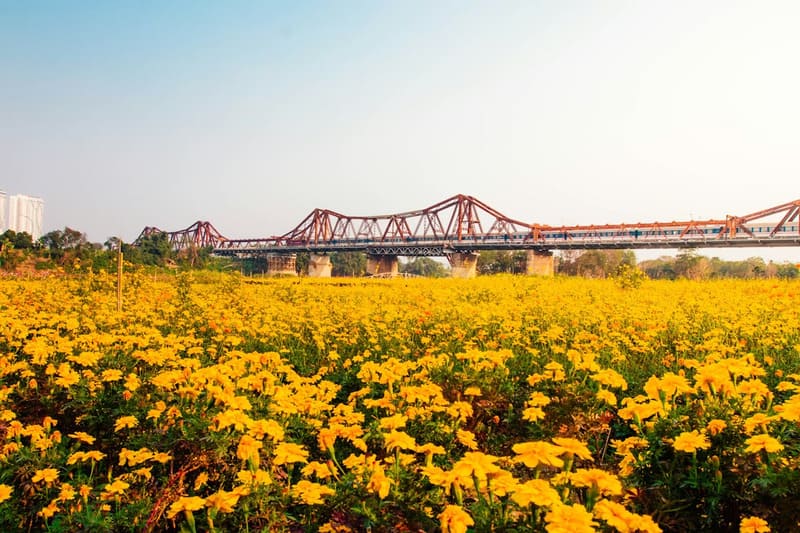
Below the bridge, seasonal flower gardens bloom along the riverbanks. Depending on the time of year, visitors may see fields of cosmos, daisies, or sunflowers.
These gardens are popular with local photographers and couples taking photos. The colorful flowers combined with the historic bridge in the background create beautiful photo opportunities.
A short walk across the bridge can easily be combined with a visit to these riverside gardens.
 |
|
Red River Flower Garden with Long Bien Bridge view (Source: Unsplash) |
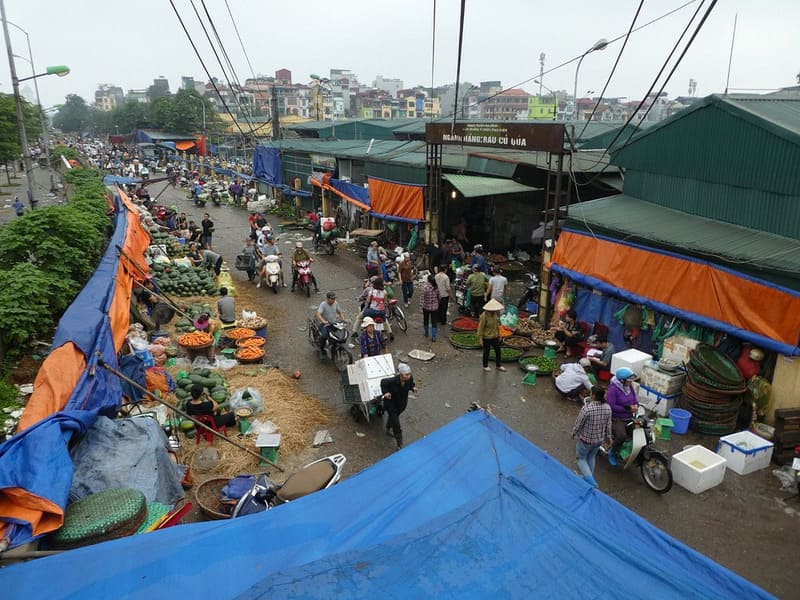
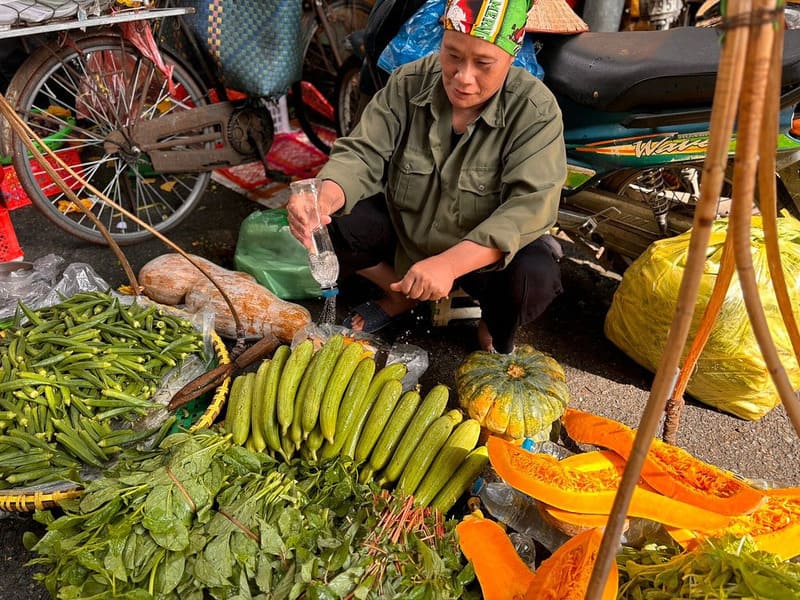
Located near the southern end of the bridge, Long Bien Market is one of Hanoi’s largest wholesale produce markets. The market becomes especially lively late at night and in the early hours of the morning.
From around 10:00 PM until dawn, trucks unload large quantities of fruits and vegetables while vendors quickly distribute them to retailers across the city. The busiest hours typically occur between 2:00 AM and 4:00 AM.
The energetic atmosphere, bright lights, and constant movement make the market a fascinating place to observe local trade in action.
Tip: Wear closed shoes and keep personal belongings secure, as the market can be crowded and fast-paced.
 |
|
View of Long Bien Market on a normal day (Source: Tripadvisor) |
 |
|
A vegetable kiosk at Long Bien Market (Source: Tripadvisor) |
Suggested Mini Itinerary:
For visitors wanting to combine several experiences, a simple itinerary might look like this:
Travelers staying nearby may also return early the next morning to photograph the river under soft morning mist.
Travelers who prefer a more structured local experience can also explore the bridge area, nearby river islands, and hidden villages on a half-day cycling route, or discover Hanoi by night on a Vespa tour that includes food, local nightlife, and a ride across Long Bien Bridge.
To enjoy a more relaxed visit, it is best to avoid peak commuting hours, which typically occur around:
For photography, the most beautiful moments are sunrise and sunset. Early morning often brings soft mist over the Red River, while late afternoon light highlights the bridge’s historic steel structure.
Long Bien Bridge is located just east of Hanoi’s Old Quarter, making it easy to reach from many central attractions. Visitors can walk, take a taxi, or use ride-hailing services depending on their schedule and starting point.
From Hoan Kiem Lake, the bridge is about a 15-minute walk through the northern part of the Old Quarter.
A common route is to walk toward Dong Xuan Market, then continue along Tran Nhat Duat Street until reaching Long Bien Railway Station. From here, stairways and ramps lead up to the pedestrian walkway on the bridge.
This route is a pleasant way to explore the Old Quarter while gradually approaching the Red River.
Taking a taxi or ride-hailing service such as Grab is the easiest option for travelers who prefer a quick trip.
You can ask the driver to stop at one of these points:
Both entry points allow easy access to the pedestrian walkway.
Motorbikes use the side lanes of the bridge and are a common way for locals to cross the river.
If you plan to ride across the bridge:
Long Bien Bridge is both a historic site and an active transportation route. Visitors should follow basic safety guidelines while exploring the bridge.
Long Bien Bridge is located just east of Hanoi’s Old Quarter and stretches across the Red River, connecting Hoan Kiem District with Long Bien District. The southern entrance of the bridge is near Long Bien Railway Station on Tran Nhat Duat Street, making it easily accessible from many central attractions.
Long Bien Bridge is famous for its historical significance and distinctive steel truss design. Built between 1899 and 1902 during the French colonial period, it was once one of the longest bridges in Asia. The bridge also became a symbol of Hanoi’s resilience after surviving heavy bombing during the Vietnam War.
Yes, visitors can walk across Long Bien Bridge using the pedestrian walkway located on both sides of the structure. Walking across the bridge allows travelers to enjoy views of the Red River, observe daily local life, and see trains passing through the central railway track.
Long Bien Bridge is generally safe to visit, but it remains an active transport route used by trains, motorbikes, and pedestrians. Visitors should stay on the designated pedestrian walkway, remain behind safety barriers, and avoid standing on the railway tracks.
Several interesting places are located near Long Bien Bridge, including Long Bien Market, the Red River Flower Gardens, Dong Xuan Market, and Long Bien Railway Station. Many visitors also explore the nearby Old Quarter or stop at cafés overlooking the bridge.
With the information above, we hope this guide helps you better understand the history, architecture, and atmosphere of Long Bien Bridge. From its century-old steel structure to the daily rhythm of trains, bicycles, and pedestrians crossing the Red River, the bridge offers a unique glimpse into Hanoi’s past and present.
If you would like to experience Long Bien Bridge beyond a simple visit, you can include it in a more immersive Hanoi itinerary. For a daytime adventure, the Half Day Hanoi Bike Tour | Red River & Hidden Villages takes you across Long Bien Bridge and into the quiet river islands, local villages, and countryside landscapes beyond the city center.
If you prefer to discover Hanoi after dark, the Hanoi Vespa Tour: Food, Night & Countryside Experience offers a lively mix of street food, hidden alleys, local nightlife, and a memorable ride across Long Bien Bridge on a vintage Vespa.

 Vietnam Tours
 Cambodia Tours
 Laos Tours
 Thailand Tours
 Multi-Country Tours