Among the heritage landmarks in Hoi An Ancient Town, Fujian Assembly Hall stands out for its ornate Chinese architecture, spiritual atmosphere, and connection to Hoi An’s maritime trading past. Built by the Fujian Chinese community, the hall served as both a place of worship and a gathering space for merchants. This guide covers its history, architecture, religious meaning, visitor information, and practical tips for a more meaningful visit.
| Information | Details |
|---|---|
| Official name | Assembly Hall of the Fujian Chinese Congregation |
| Common names | Fujian Assembly Hall, Phuc Kien Assembly Hall, Hoi Quan Phuc Kien, Phuc Kien Pagoda |
| Vietnamese name | Hội quán Phúc Kiến |
| Address | 46 Tran Phu Street, Hoi An Ancient Town |
| Main worship | Thien Hau, also known as Mazu, the Goddess of the Sea |
| Historical role | Assembly hall, temple, and community center for Fujian Chinese merchants |
| Architectural style | Traditional Southern Chinese / Fujian-influenced architecture |
| Recognition | Part of Hoi An Ancient Town UNESCO World Heritage Site |
| Suggested visit duration | Around 30–45 minutes |
| Best for | History lovers, architecture enthusiasts, cultural travelers, photographers |
Fujian Assembly Hall is widely regarded as one of the largest and most striking Chinese assembly halls in Hoi An. Its elaborate gate, ceremonial courtyards, incense-filled halls, and sacred altars make it one of the Old Town’s most memorable heritage attractions.
Fujian Assembly Hall is a historic religious and communal complex built by immigrants and merchants from Fujian Province in southeastern China. During Hoi An’s peak as a busy international trading port from the 16th to 18th centuries, different Chinese communities established their own assembly halls to support newcomers, preserve traditions, hold meetings, and worship patron deities.
The Fujian congregation became one of the most influential Chinese groups in Hoi An, and their assembly hall developed into both a community center and a place of worship. Today, it remains active as a spiritual site where local residents and visitors come to burn incense, pray for safety, prosperity, fertility, and family blessings.
Unlike a simple historical monument, Fujian Assembly Hall is still a living cultural space. Its altars, offerings, ceremonial objects, and religious festivals show how Hoi An’s Chinese heritage continues to shape the identity of the ancient town.
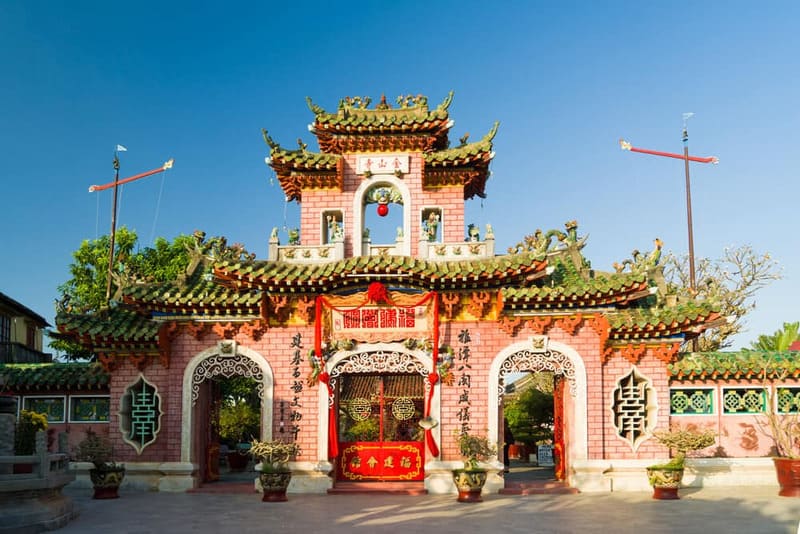
Fujian Assembly Hall, a cultural landmark in Hoi An (Source: Collected)
The site of Fujian Assembly Hall is closely connected with the migration of Chinese communities to Hoi An during the late 17th and 18th centuries. According to heritage records, the complex was established by the Fujian Chinese congregation and became one of the most important Chinese community buildings in the trading port.
Many accounts note that the location originally housed a smaller Buddhist temple known as Kim Son Tu, or Golden Mountain Temple. After the structure deteriorated, Fujian merchants acquired the site, renovated it, and transformed it into an assembly hall dedicated primarily to Thien Hau, the protector of seafarers and merchants. Over time, the complex was expanded and restored, resulting in the ornate architectural ensemble visitors see today.
The hall reflects a key chapter in Hoi An’s history. As a port linked with China, Japan, Southeast Asia, and Europe, Hoi An attracted merchants who settled permanently, formed neighborhood communities, and created institutions that served both practical and spiritual needs. Fujian Assembly Hall stands as one of the clearest architectural records of that multicultural past.
It was also recognized as an important historic and cultural relic, reinforcing its value as one of Hoi An’s essential heritage landmarks.
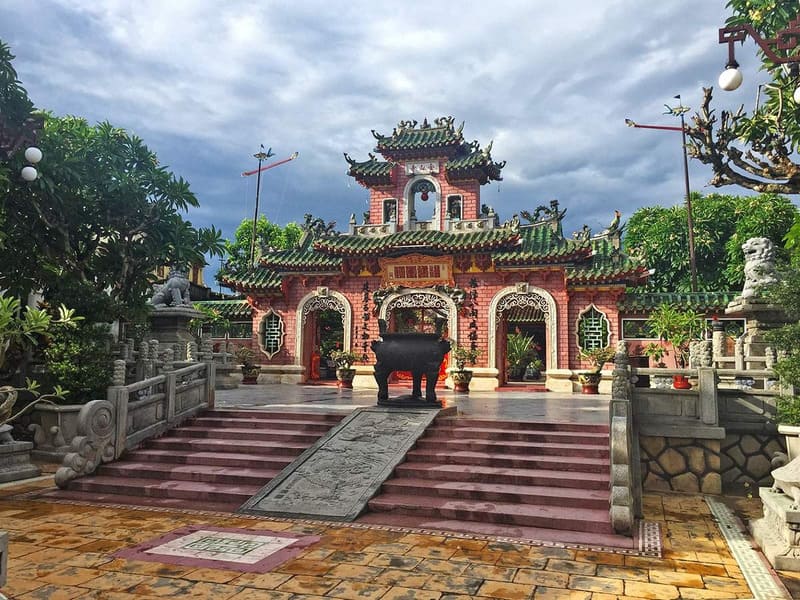
Fujian Assembly Hall reflects Hoi An’s trading past (Source: Collected)
Thien Hau, also known as Mazu, is one of the most widely revered sea deities in Chinese folk religion. She is especially important among coastal and maritime communities in Fujian, Guangdong, Taiwan, and Chinese diaspora settlements across Southeast Asia.
In traditional belief, Thien Hau protects sailors, traders, and fishermen from storms and dangers at sea. This explains why she became the central deity of Fujian Assembly Hall. Hoi An’s Chinese merchants depended heavily on long-distance sea routes, so worshipping Thien Hau was both an act of faith and a reflection of their daily lives.
Inside the main worship hall, Thien Hau is usually shown in a central position, accompanied by her two legendary guardians:
Together, they symbolize divine protection for people traveling over water.
The hall also includes shrines connected with other beliefs, including Guanyin, the God of Wealth, the Six Fujian Generals, and the Twelve Midwives, who are associated with pregnancy and childbirth blessings. This layered religious landscape makes Fujian Assembly Hall much more than a single-deity temple; it is a sacred space where folk religion, Buddhist influence, ancestral reverence, and community memory intersect.
Fujian Assembly Hall is one of the finest examples of Chinese-influenced religious architecture in Hoi An. The complex is admired not only for its scale but also for its rich decorative program, spatial arrangement, and symbolic details.
The assembly hall follows a traditional layered arrangement often described as a three-part composition, with courtyards and worship spaces aligned along a central axis. Visitors generally move through:
This progression creates a gradual transition from the public street into a more solemn spiritual environment.
The most recognizable feature of Fujian Assembly Hall is its triple-arched gate, richly decorated with curved rooflines, ceramic figures, dragons, lions, and other auspicious motifs. The gate is often the first element visitors photograph because it is both monumental and highly colorful.
Its three entrances are commonly associated with traditional symbolic ideas such as Heaven, Earth, and Humanity, while the decorated roof reflects Southern Chinese artistic influence. Plaques with Chinese characters above the structure reinforce the hall’s Fujian identity and sacred function.
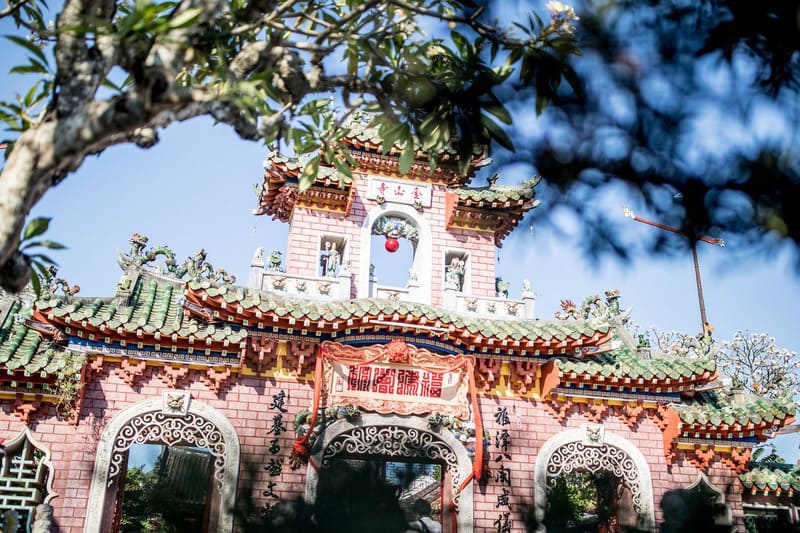
The colorful three-arched gate of Fujian Assembly Hall (Source: Collected)
The roofs feature elaborate mosaic and porcelain decorations. Dragons, phoenixes, turtles, fish, and other creatures appear along the ridges and edges, expressing themes of protection, longevity, transformation, and prosperity.
These roof ornaments are among the most visually impressive details of the complex. They also connect the building with the broader tradition of temple decoration in Southern China, where rooftops often become symbolic storytelling surfaces.
Inside the complex, visitors encounter open courtyards with plants, stone features, and ornamental ponds. Carp imagery appears in some decorative elements, evoking ideas of perseverance and transformation in Chinese symbolism.
Wooden beams, altar frames, lacquered boards, parallel calligraphy panels, and carved doorways add further detail. The interiors are not visually empty; they are dense with inscriptions, religious imagery, and craftsmanship that reward slow observation.
A visit to Fujian Assembly Hall is most rewarding when you look beyond the façade and take time to understand the objects and spaces inside.
The spiritual heart of the hall is the central altar dedicated to Thien Hau. Her image is usually placed prominently in the main worship area, surrounded by candles, incense, offerings, and decorative objects.
This altar reflects the deep relationship between Hoi An’s merchant communities and maritime travel. For historical traders who crossed unpredictable seas, Thien Hau was not a distant figure but a guardian linked directly to survival, fortune, and safe return.
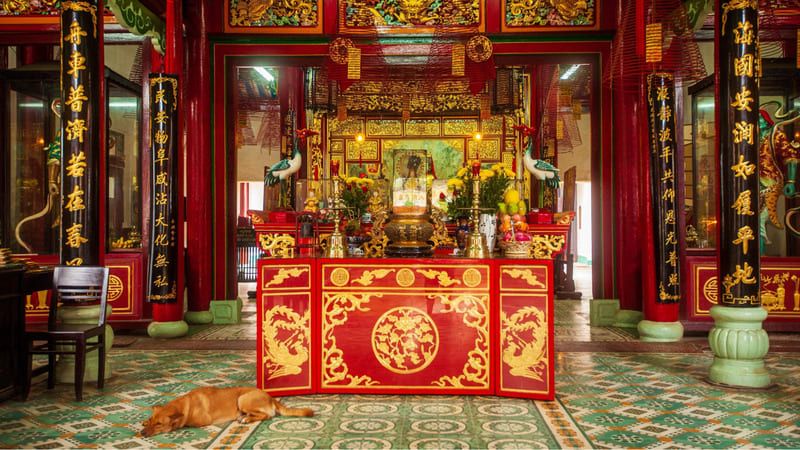
The main worship hall dedicated to Thien Hau (Source: Collected)
Standing near the central deity are Thien Ly Nhan and Thuan Phong Nhi, the two divine assistants of Thien Hau. Their vivid, commanding forms are among the most memorable statues in the hall.
These figures help explain the temple’s maritime symbolism:
For visitors, they are a small but powerful introduction to the mythology surrounding Mazu worship.
Large spiral incense coils often hang overhead in the worship areas. Attached prayer tags may carry names, wishes, or petitions from devotees. The fragrance of incense is one of the most distinctive sensory impressions of the site.
These coils contribute greatly to the atmosphere. They make the hall feel active and devotional rather than museum-like. Travelers who are sensitive to incense smoke may prefer to visit during quieter hours.
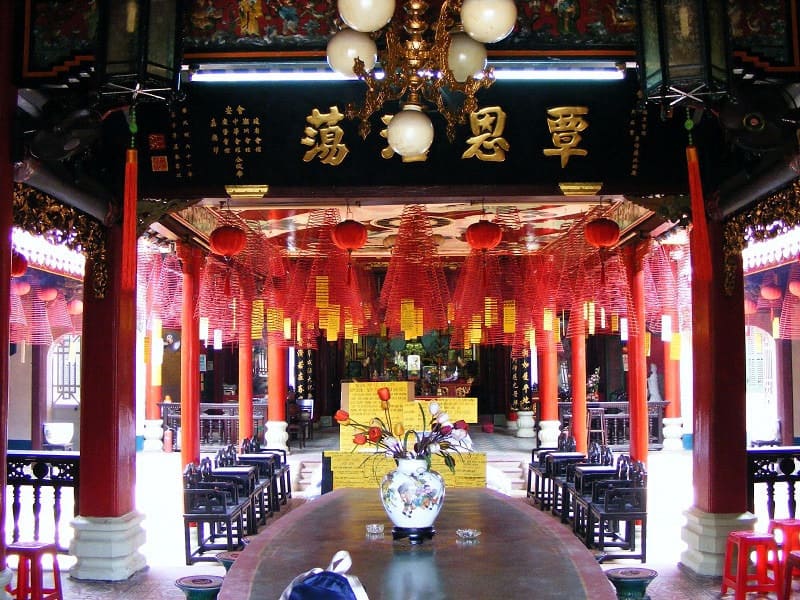
Incense coils create a sacred atmosphere inside (Source: Collected)
A model trading boat is displayed inside the hall, recalling the sea routes that connected Fujian merchants with Hoi An. Boats are essential to the story of this place: the assembly hall developed in a port town, and its main deity protected those who navigated the coast.
This object helps connect architecture, religion, and commerce into one narrative of migration and maritime trade.
The rear areas of the hall contain additional altars honoring important figures and deities linked to the Fujian community. Depending on the specific arrangement, visitors may encounter shrines associated with:
These rear chambers show that Fujian Assembly Hall served multiple spiritual needs, from honoring heroic loyalty and ancestral roots to praying for children and family well-being.
Fujian Assembly Hall is not only visited by tourists; it remains a meaningful place for ceremonies and community observances. Several religious events are associated with the hall throughout the lunar year.
The most important ceremony is dedicated to Thien Hau, traditionally held on the 23rd day of the third lunar month. Local devotees prepare offerings, incense, flowers, and ritual objects to honor the sea goddess and pray for protection and prosperity.
This is one of the best times to witness the assembly hall as an active spiritual center rather than a quiet heritage monument.
Another important observance honors the Six Generals, also known in Vietnamese as Luc Tanh Vuong Gia. These figures are remembered in the religious traditions of some Fujian communities and are associated with loyalty and collective identity.
The hall is also known for worship connected with the Twelve Midwives, figures associated in Vietnamese and Chinese folk belief with pregnancy, childbirth, and child protection. Couples and families may come to pray for fertility, safe delivery, or the health of young children.
Hoi An’s Chinese community also observes broader lunar festivals such as Nguyen Tieu Festival, which is celebrated in the old town and may involve activity at Chinese assembly halls, including Fujian Assembly Hall.
Opening hours may vary slightly by source and local management, but Fujian Assembly Hall is generally open during daytime sightseeing hours in Hoi An Ancient Town. Travelers should plan their visit in the morning or afternoon and check locally if arriving close to opening or closing time.
Fujian Assembly Hall is part of the Hoi An Ancient Town heritage sightseeing system. As of 2026, the Hoi An Old Town entrance ticket is commonly listed at:
The ticket gives access to selected heritage sites within the Old Town, and Fujian Assembly Hall is among the attractions visitors may choose to enter. Ticket policies can be updated, so travelers should confirm the latest local guidance when purchasing.
Fujian Assembly Hall is an active religious site, so respectful clothing is recommended.
Visitors should:
There is no need for formal clothing, but modest dress shows respect for the hall’s spiritual role and local customs.
The best time to visit Fujian Assembly Hall is usually:
Midday can be hotter and busier, particularly during peak tourism seasons. If you want to appreciate the architecture in detail or take clear photographs around the main gate and courtyards, visiting before the largest crowds arrive is ideal.
Travelers interested in religious culture may also consider visiting during major lunar ceremonies, especially the Thien Hau Festival. However, these days can be more crowded and less suitable for a quiet, slow-paced visit.
If you are planning to explore multiple heritage sites, understanding the best time to visit Hoi An can help you avoid crowds, heavy rain, and extreme heat.
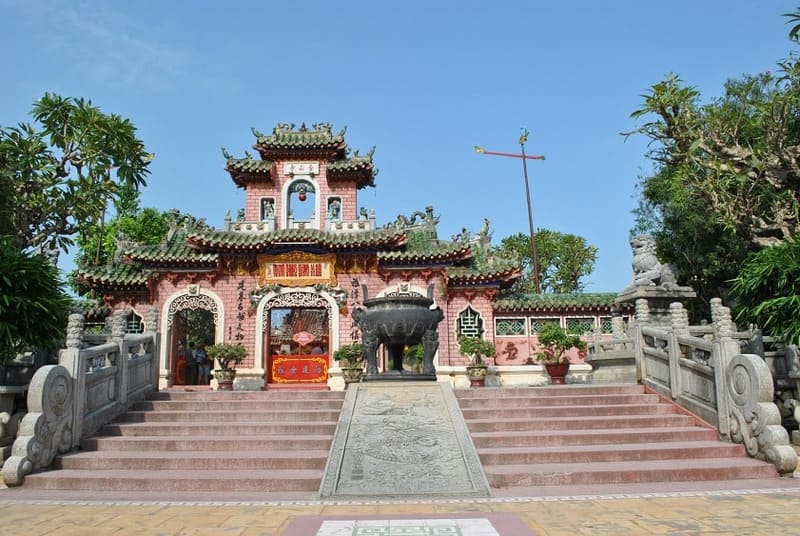
Early visits offer softer light and fewer crowds (Source: Collected)
Fujian Assembly Hall is located at 46 Tran Phu Street, within the walkable core of Hoi An Ancient Town. It is easy to reach on foot from many of the Old Town’s major landmarks.
The hall is about a short walk from the Japanese Covered Bridge, one of Hoi An’s most famous symbols. Following the streets through the ancient town toward Tran Phu Street leads you directly to the assembly hall area.
The hall is also close to Hoi An Central Market, making it convenient to combine a cultural visit with local food, riverside walking, or shopping nearby.
If you are staying in or near the Old Town:
The central heritage zone is best experienced slowly on foot, especially because many streets prioritize pedestrians during busy periods.
Fujian Assembly Hall fits naturally into a half-day walking route around Hoi An Ancient Town. Nearby places worth combining with your visit include:
These attractions help turn a single monument visit into a richer exploration of Hoi An’s multicultural history.
To make the most of your visit, here are several practical tips that can help you better appreciate the history, architecture, and atmosphere of Fujian Assembly Hall:
Most visitors should plan for around 30-45 minutes. This gives enough time to admire the gate, walk through the courtyards, explore the worship halls, and notice the religious statues and symbolic decorative details. Travelers with a strong interest in architecture or local religion may spend longer.
Yes. Fujian Assembly Hall is one of the most rewarding heritage sites in Hoi An because it combines history, architecture, religion, and community memory in a single place. It is especially worthwhile for travelers interested in Chinese influence on Hoi An’s trading-port culture.
Photography is generally allowed in visitor areas, but travelers should remain respectful near altars and people who are praying. Avoid using flash in a disruptive way, blocking worship spaces, or treating religious objects like photo props.
Wear modest, respectful clothing suitable for a spiritual site. Shoulders and the upper body should be appropriately covered, and overly revealing outfits are best avoided.
Yes. The hall is easy to visit independently, especially if you are already exploring Hoi An Ancient Town. However, a guide can add valuable context about Thien Hau worship, Fujian migration, Minh Huong history, and the symbolism of the architecture.
Yes. Fujian Assembly Hall is part of the Hoi An Ancient Town heritage attraction system. Visitors typically use the Old Town sightseeing ticket to enter selected monuments within the heritage area, including this assembly hall. As of 2026, the ticket system remains in use, though exact policies should be checked at local ticket counters before visiting.
A visit to Fujian Assembly Hall reveals an important part of Hoi An Ancient Town’s multicultural heritage. From the shrine of Thien Hau to the colorful rooftops, incense coils, and symbolic decorations, the hall reflects the role of Chinese merchant communities in shaping the town’s history. For travelers interested in culture, architecture, or photography, it is one of the most worthwhile heritage sites to include in a Hoi An itinerary.



 Vietnam Tours
 Cambodia Tours
 Laos Tours
 Thailand Tours
 Multi-Country Tours