Trieu Chau Assembly Hall is one of five historic Chinese assembly halls in Hoi An Ancient Town. Built by the Teochew community in 1845, the site is known for its elaborate wood carvings, ceramic reliefs and altars dedicated to deities associated with maritime safety, prosperity and community protection. This guide covers its history, architecture, entrance information and practical tips for planning a visit.
Trieu Chau Assembly Hall is a 19th-century religious and communal building established by immigrants from Chaozhou, a coastal region in eastern Guangdong Province, China. It is also known as:
“Trieu Chau” is the Vietnamese form of Chaozhou, while “Teochew” is a widely used romanization associated with the region, its people and language.
The hall originally served as a place where Teochew merchants and migrants could meet, maintain community connections, worship protective deities and assist fellow members living in Hoi An. Its location reflects the important role Chinese merchant communities played in the development of the town as an international trading port.
Today, the building remains an active place of worship and community gathering. It is also one of the heritage attractions included in Hoi An Ancient Town’s sightseeing system.
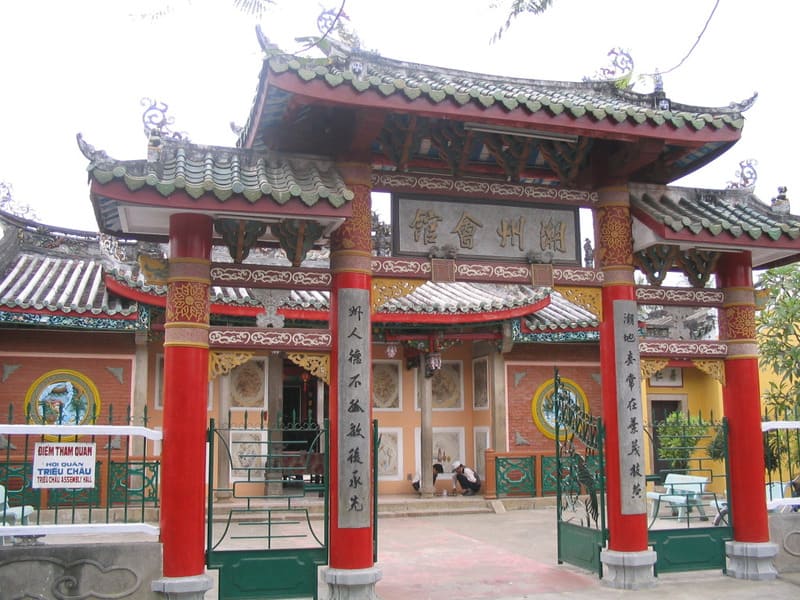
Trieu Chau Assembly Hall in Hoi An Ancient Town (Source: Collected)
Trieu Chau Assembly Hall is located at 157 Nguyen Duy Hieu Street, near the eastern end of Hoi An Ancient Town.
Admission is generally covered by the Hoi An Ancient Town sightseeing ticket rather than sold as a separate ticket exclusively for the assembly hall. A standard international ticket usually allows entry to five listed heritage attractions, including selected assembly halls, ancient houses, museums, temples and performance venues. One coupon is collected when visitors enter each chosen site.
Ticket booths can be found around the entrances to the heritage area. Visitors staying outside the Old Town can purchase a ticket before beginning their sightseeing route.
Trieu Chau Assembly Hall was founded in 1845 by overseas Chinese residents from Chaozhou. It provided a shared space for religious ceremonies, community meetings, ancestor worship and mutual support among Teochew merchants living and trading in Hoi An.
Between the 16th and 19th centuries, Hoi An was one of Southeast Asia’s most active maritime trading ports. Merchants from China, Japan, India and Europe arrived to trade silk, ceramics, spices and other goods. Several Chinese communities settled in the town and established their own assembly halls according to their places of origin.
The Teochew people came from a coastal region with a long tradition of seafaring, commerce and migration. For merchants whose livelihoods depended on river and sea routes, dangerous weather, rough waves and long-distance voyages were constant concerns. Their assembly hall therefore became closely associated with worship intended to secure calm seas, favorable winds, safe journeys and successful business.
The building was originally constructed mainly from timber. It was repaired and expanded over time through contributions from members of the local Teochew community. Although smaller than several other Chinese assembly halls in Hoi An, it has preserved its traditional religious function and many distinctive decorative features.
The hall also demonstrates how immigrant communities adapted to life in Hoi An while retaining their language, beliefs, artistic traditions and social networks. It remains evidence of the multicultural history that contributed to Hoi An Ancient Town’s UNESCO World Heritage status.
Trieu Chau Assembly Hall combines the functions of a temple, ancestral hall and community meeting place. Its architecture is arranged around an internal courtyard, allowing light and ventilation to reach the principal worship and meeting spaces.
The complex includes an entrance gate, front hall, side wings, open courtyard and main sanctuary. These spaces create an enclosed layout in which visitors gradually move from the public entrance toward the more sacred worship area.
Although the building appears relatively modest from the street, closer inspection reveals detailed wood carving, colorful ceramic work, calligraphy, lacquered plaques and symbolic images.
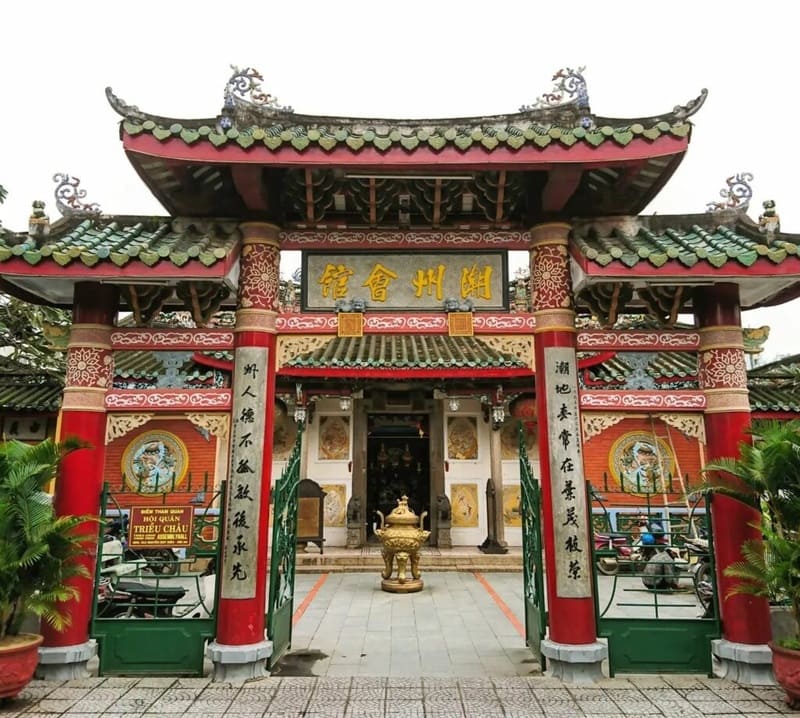
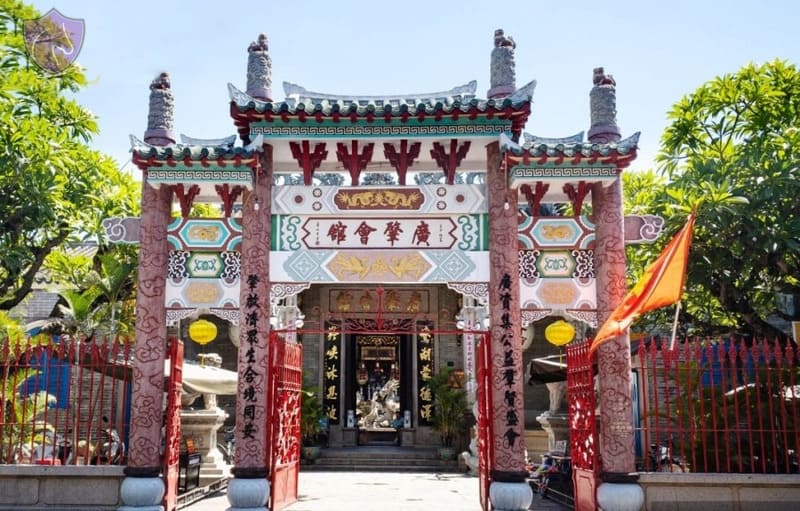
The street-facing gate is one of the assembly hall’s most recognizable features. Red pillars support green-tiled roofs with upward-curving corners, reflecting Southern Chinese architectural traditions.
A horizontal plaque bearing the name of the assembly hall is positioned above the central entrance. Vertical Chinese couplets appear on the surrounding pillars, expressing wishes for protection, harmony, prosperity and the continuation of the community.
The facade is decorated with reliefs and mosaics depicting auspicious subjects such as:
The curved roof ridges are embellished with ceramic figures and ornamental details. These elements give the entrance a layered appearance while introducing the artistic motifs repeated throughout the complex.
The gate is an excellent place to observe the contrast between red columns, yellow walls, green roof tiles and multicolored porcelain decoration. Early morning usually provides softer light and fewer people for exterior photographs.
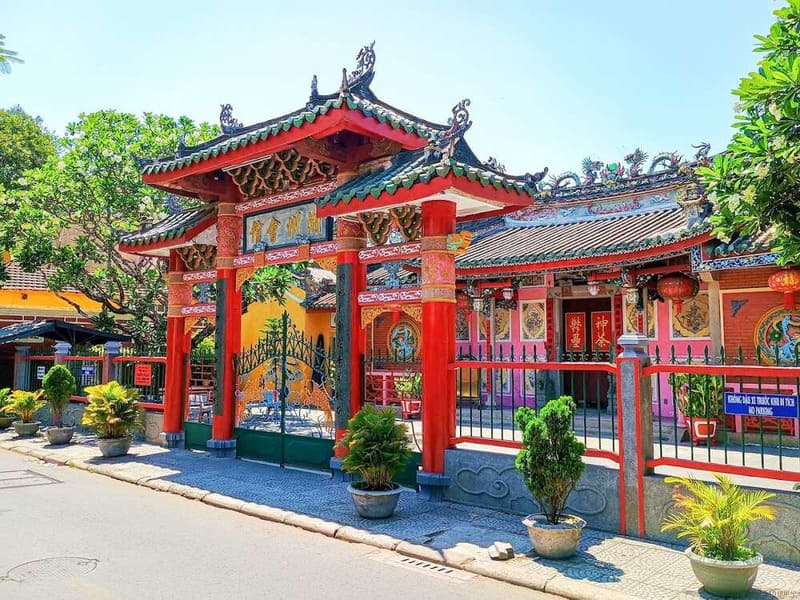
The colorful entrance of Trieu Chau Assembly Hall (Source: Collected)
After passing through the gate, visitors enter the front section of the assembly hall. The timber-framed structure contains carved beams, doors and decorative panels.
The front hall once functioned as a reception and transitional space. Guests could be welcomed here before entering the central courtyard or proceeding toward the main sanctuary. It may also be used to display objects, plaques or items connected with community ceremonies.
Beyond the front hall is an open courtyard enclosed by the surrounding buildings. This arrangement is influenced by traditional Chinese courtyard architecture and helps separate the assembly hall from the busy street outside.
Plants, potted trees and an incense burner add to the quiet atmosphere. The courtyard also provides a clear view of the roofs, columns and carved timber elements surrounding the main worship area.
The eastern and western wings historically served several purposes. They provided rooms for community meetings, ancestor worship, guest reception and the commemoration of people who contributed to the construction and development of the hall.
Visitors should pause in the courtyard rather than walking directly into the sanctuary. Many decorative details can be seen beneath the eaves, on the column brackets and around the doors.
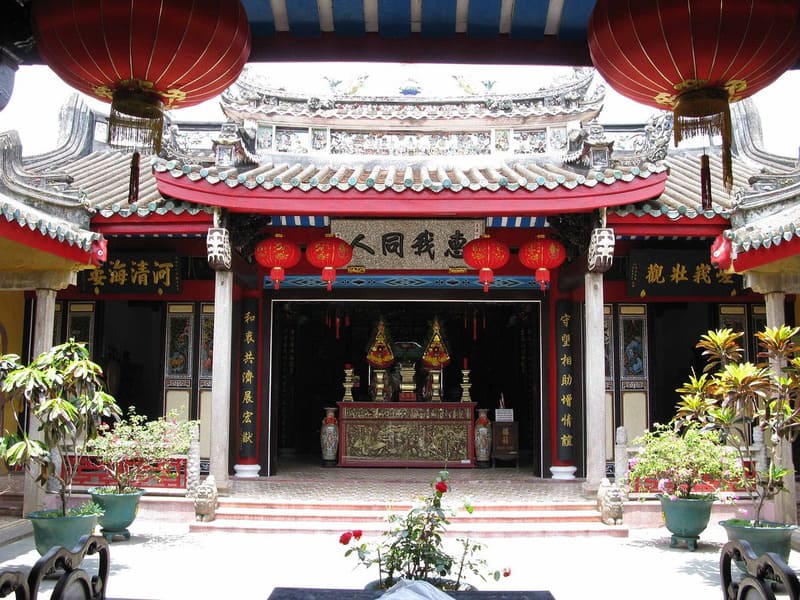
A quiet courtyard framed by historic wooden halls (Source: Tripadvisor)
The main worship hall is the spiritual center of Trieu Chau Assembly Hall. It contains multiple altars arranged within a richly decorated timber interior.
The central altar is associated with Phuc Ba General, a deity linked to control over wind and waves. He is often identified with General Fubo, a title meaning “General Who Calms the Waves.” Within the context of the assembly hall, worship focuses on protection at sea, favorable weather and safe travel.
Additional altars are dedicated to deities connected with prosperity and local protection, including:
Offerings commonly include incense, flowers, tea and fruit. More elaborate food offerings may be presented during important ceremonies.
Visitors may enter the worship area when it is open, but should avoid standing directly in front of people praying, touching altar objects or interrupting rituals.
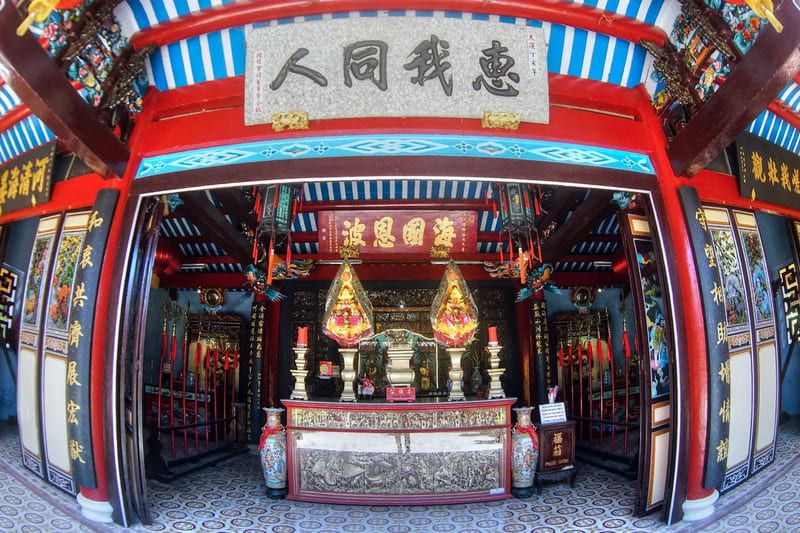
Inside the sacred main hall and worship area (Source: Collected)
Wood carving is one of the most valuable artistic features of Trieu Chau Assembly Hall. Teochew carving developed into a highly detailed decorative tradition known for layered compositions, precise craftsmanship and lively representations of animals, plants and narrative scenes.
Carved elements can be found on:
Common motifs include dragons, phoenixes, flowers, birds and marine life. These subjects were selected for their symbolic meanings. Dragons represent authority and auspicious power, phoenixes suggest harmony and virtue, while fish are associated with abundance and success.
Many carvings contain several overlapping layers, giving the design a three-dimensional appearance. The finest details can be easy to miss in the dim interior, so visitors should examine the windows, beam ends and altar screens closely.
The woodwork also distinguishes the hall from attractions that impress primarily through size. Trieu Chau Assembly Hall rewards slower observation, particularly for travelers interested in traditional craftsmanship.
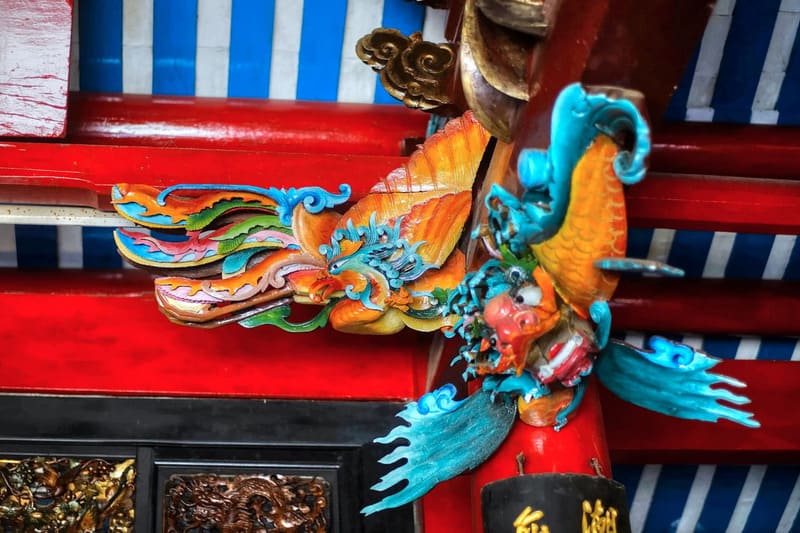
Colorful Teochew wood carving inside the assembly hall (Source: Collected)
The roof, facade and surrounding walls feature decorative reliefs assembled from ceramic and porcelain fragments. This technique allows artisans to create brightly colored figures that remain visually prominent under sunlight.
Porcelain mosaics depict mythical creatures, flowers, aquatic animals and scenes derived from Chinese legends. Broken ceramic pieces are carefully cut and arranged to create scales, feathers, clothing and foliage.
Several of the most recognizable images include dragons, carp and the Four Sacred Animals commonly found in East Asian religious art. The decorations are intended to beautify the building while expressing wishes for protection, achievement, longevity and prosperity.
Ceramic reliefs are concentrated around the entrance, roof ridges and wall panels. Viewing them from different angles helps reveal details that may not be visible when standing directly beneath the roof.
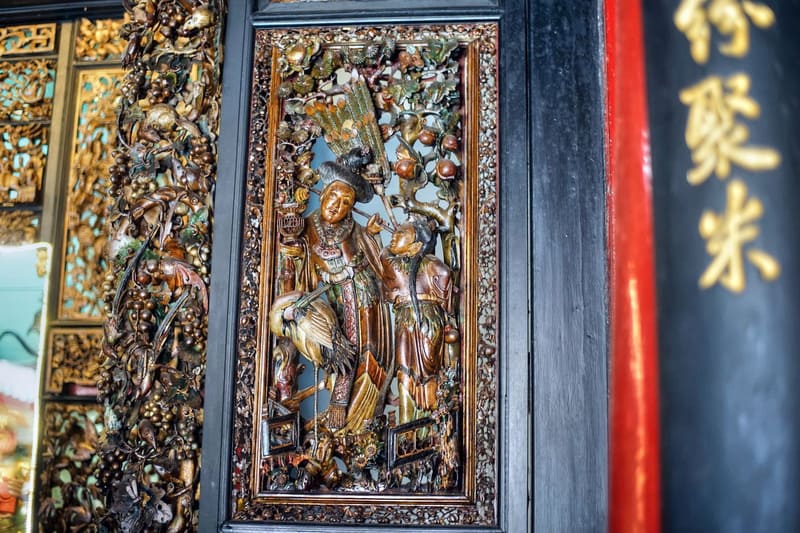
Intricate ceramic relief inside Trieu Chau Assembly Hall (Source: Collected)
Chinese calligraphy appears throughout the assembly hall on horizontal plaques, vertical couplets, altar panels and commemorative tablets. These inscriptions record the identity of the congregation, honor deities and ancestors, or express moral and auspicious messages.
Many plaques are finished in red, black or dark lacquer with gold characters. Their placement above doors and altars reinforces the hierarchy of the interior spaces.
Ceremonial and communal objects may include:
Some rooms also contain furniture used for meetings and formal community gatherings. These objects demonstrate that the building was designed as a functioning social institution rather than solely as a sightseeing attraction.
Trieu Chau Assembly Hall is located on Nguyen Duy Hieu Street, just a short walk from many of Hoi An's main attractions.
If you're exploring Hoi An on foot, Trieu Chau Assembly Hall is easy to include alongside nearby attractions such as Fujian Assembly Hall, Hainan Assembly Hall, and Hoi An Market.
The best times to visit are 7:00 - 9:30 AM or 3:00 - 5:00 PM, when the weather is cooler, the light is softer, and the hall is generally less crowded. Morning is ideal for photography, while late afternoon pairs well with exploring Hoi An Ancient Town and its lantern-lit streets.
For the most pleasant weather, plan your visit during Hoi An's dry season. In the rainy season, short downpours or occasional flooding may affect nearby streets, although most areas inside the assembly hall remain sheltered.
If you're interested in local traditions, visit during the Nguyen Tieu Festival (the first full moon of the lunar year), when Chinese assembly halls host traditional ceremonies to pray for peace, prosperity, and honor their ancestors.
Trieu Chau Assembly Hall is within walking distance of many landmarks in Hoi An Ancient Town, making it easy to explore several heritage sites in one trip.
To make your visit more enjoyable and respectful, keep these practical tips in mind:
Most visitors spend 30 - 45 minutes exploring the entrance gate, courtyard and main hall. If you're interested in the architecture and historical details, allow up to an hour.
The main deity is Phuc Ba General, revered as the protector of seafarers. The hall also includes altars dedicated to the God of Wealth, Phuoc Duc Chinh Than, ancestors and respected members of the Teochew community.
Yes, photography is generally allowed in the courtyard and outdoor areas. Inside the worship hall, follow posted signs, avoid flash and ask for permission before photographing altars or religious ceremonies.
Yes. The main celebration takes place around the 16th day of the first lunar month during the Nguyen Tieu festival, when the local Teochew community gathers for worship, ancestor remembrance and traditional ceremonies.
Yes. The site is compact and easy to explore with children. Parents should supervise young visitors, respect the worship areas and check the latest Hoi An Ancient Town ticket policy for child admission.
Hopefully, this guide has helped you better understand the history, architecture and cultural significance of Trieu Chau Assembly Hall. Whether you're exploring Hoi An Ancient Town for the first time or revisiting its historic landmarks, this well-preserved assembly hall offers a fascinating glimpse into the heritage of the Teochew community and remains a worthwhile stop on any Hoi An itinerary.

 Vietnam Tours
 Cambodia Tours
 Laos Tours
 Thailand Tours
 Multi-Country Tours