Located on Tran Phu Street in the heart of Hoi An Ancient Town, Hainan Assembly Hall is a historic religious and community landmark associated with the Hainanese Chinese population. The hall is known for its peaceful courtyard, traditional Chinese architecture and the moving story of 108 Hainanese merchants commemorated at its main altar.
Hainan Assembly Hall is one of the five historic Chinese assembly halls in Hoi An. It was established by immigrants and merchants from Hainan Island, China, as a place for communal meetings, religious ceremonies, ancestor worship and mutual support.
The hall is also known by several other names, including:
During Hoi An’s development as an international trading port, Chinese communities arriving from Fujian, Guangdong, Chaozhou and Hainan formed their own congregations. Each community built an assembly hall where members could worship regional deities, meet other merchants, resolve communal matters and maintain cultural connections with their homeland.
Hainan Assembly Hall served these social functions, but its religious significance is especially important. The principal altar commemorates 108 Hainanese merchants who died during a maritime tragedy in the 19th century. They were later honored under the title Nghia Liet Chieu Ung, or “Righteous Martyrs Who Answer Prayers,” and became protective figures for Hainanese merchants, sailors and fishermen.
The site officially opened as a tourist attraction in November 2016 after a period of restoration. Despite being less widely known than other assembly halls, it remains an important part of the Chinese architectural and religious heritage preserved within Hoi An Ancient Town.
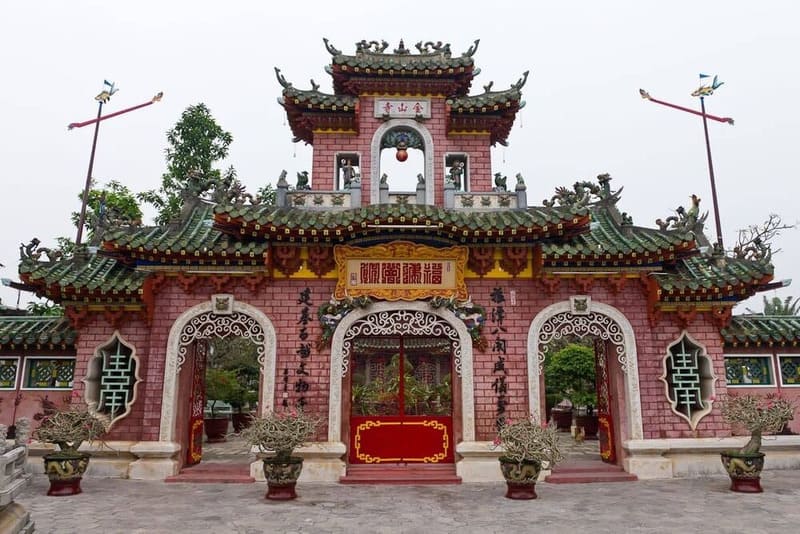
Hainan Assembly Hall in the heart of Hoi An (Source: Collected)
Hainan Assembly Hall is located at:
10 Tran Phu Street, Hoi An Ward, Da Nang City, Vietnam
It stands along the eastern section of Tran Phu Street, one of the main heritage streets running through Hoi An Ancient Town. From the Japanese Covered Bridge, the walk to Hainan Assembly Hall takes approximately 10 - 15 minutes, depending on the route and the number of stops made along the way.
Located in the heart of Hoi An Ancient Town, Hainan Assembly Hall is easy to reach on foot from most attractions.
The history of Hainan Assembly Hall is closely connected with the development of Hoi An as a major maritime trading port and the migration of Chinese merchants to Central Vietnam.
Between the 16th and 19th centuries, Hoi An welcomed trading communities from China, Japan, Europe and other parts of Asia. Chinese merchants formed regional congregations based on their places of origin. The Hainanese community used its assembly hall as a meeting place, a religious sanctuary and an institution supporting merchants living far from home.
The hall’s most important historical narrative dates to 1851, during the reign of Emperor Tu Duc of the Nguyen Dynasty.
A vessel carrying Hainanese merchants was involved in a deadly incident while traveling through Vietnamese waters. The passengers were wrongly identified as pirates and killed by members of a local maritime force seeking to seize their cargo.
The victims were later determined to have been innocent merchants. After the case was investigated, the people responsible were punished, while the property taken from the vessel was confiscated.
Emperor Tu Duc granted the victims the honorific title Nghia Liet Chieu Ung. The designation recognized them as righteous martyrs and allowed the Hainanese community to establish a shrine where they could be commemorated.
The victims subsequently became known as the 108 Hainanese Brothers. Their worship gradually spread among Hainanese communities, particularly merchants, sailors and fishermen who prayed for protection during sea voyages.
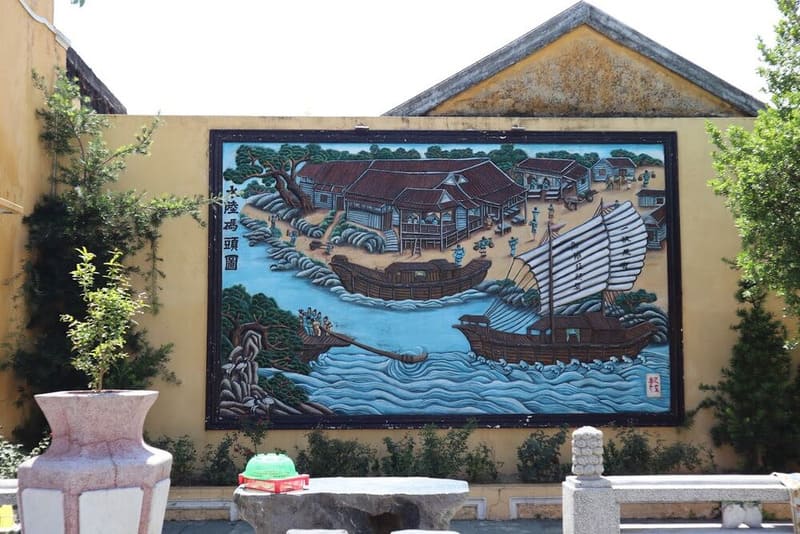
The mural recalls Hoi An’s maritime trading past (Source: Collected)
Hainan Assembly Hall traces its formal establishment to 1875, when the Hainanese community developed a communal and religious institution around the shrine dedicated to the 108 Brothers.
Construction of the larger complex began during the following years, with many architectural components and decorative materials produced by craftsmen and transported from Hainan. The main complex was completed toward the end of the 19th century, around 1891.
Unlike several other Chinese assembly halls in Hoi An that were financed mainly through community donations, Hainan Assembly Hall also benefited from support associated with the imperial settlement of the maritime tragedy.
The hall was substantially restored in 1931 and 1971. Further conservation work was carried out before the building officially opened to tourists on November 23, 2016.
Today, the hall continues to serve both as a heritage attraction and an active spiritual space for members of the local Hainanese community.
Hainan Assembly Hall occupies a long rectangular site between Tran Phu and Phan Chu Trinh streets. Its layout follows a traditional Chinese central axis, connecting the entrance, courtyard, side wings, worship pavilion and main sanctuary.
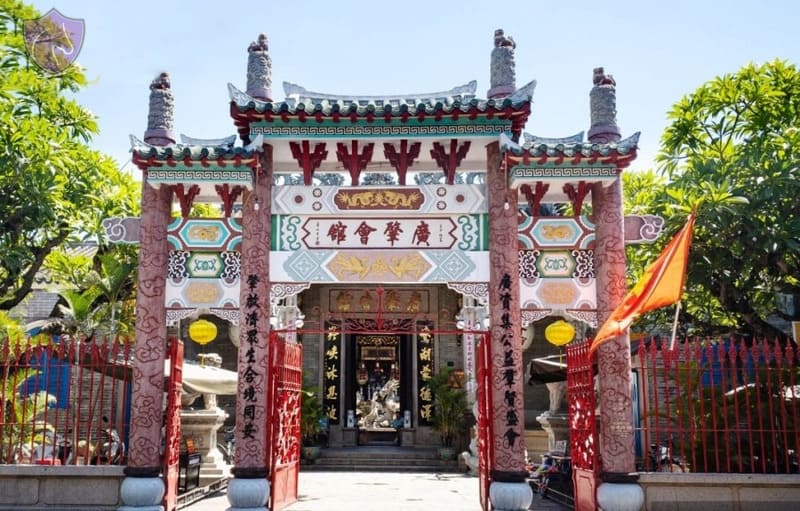
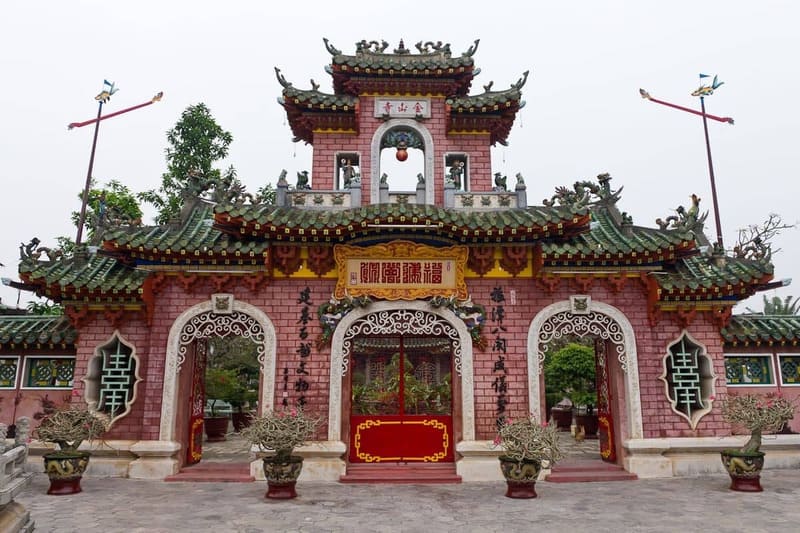
Unlike the typical three-door gates seen at many Chinese religious buildings, the assembly hall has a simpler street-facing entrance. Chinese characters above the doorway identify it as the meeting place of the Hainanese congregation.
The yellow façade blends naturally with Hoi An’s historic streetscape, while the front hall once served as a reception and meeting area. Visitors can also find a small Earth God shrine and information panels explaining the history of the community and the 108 Hainanese Brothers.
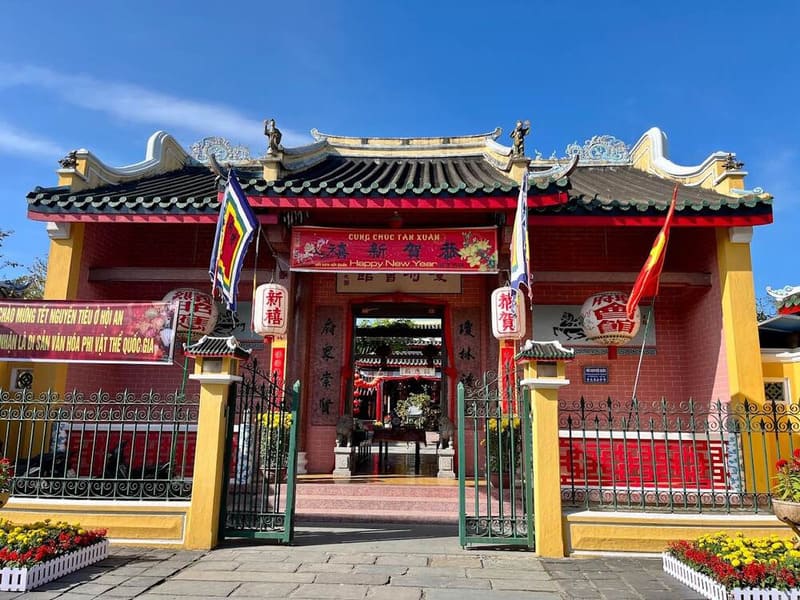
The yellow entrance blends into Hoi An Old Town (Source: Collected)
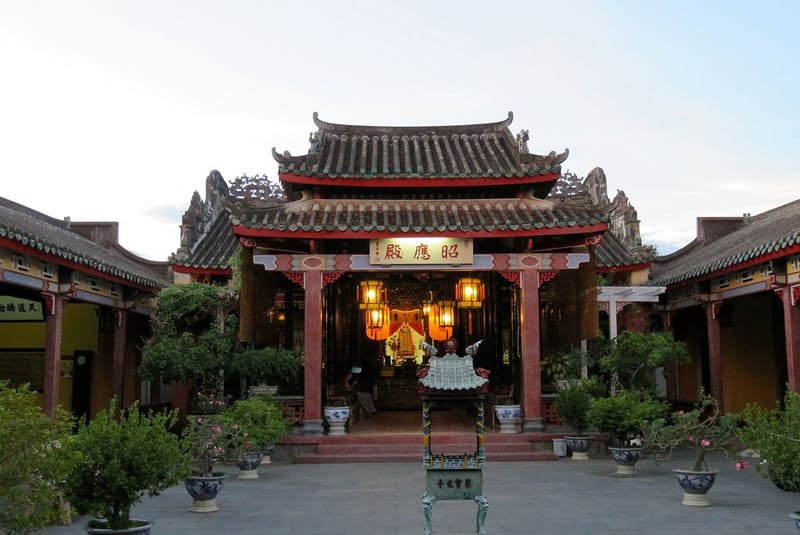
The open courtyard forms the visual center of the complex. Bonsai, potted plants and seasonal flowers soften the architecture, while the open space provides natural light and ventilation.
A straight pathway leads toward the sanctuary, creating a calm transition from the communal entrance area to the main worship space.
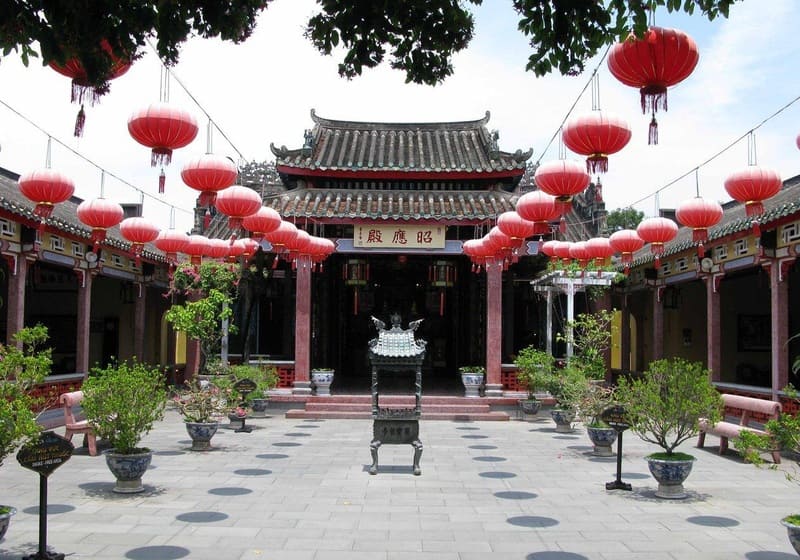
A quiet courtyard filled with plants and sunlight (Source: Collected)
Covered wings on both sides of the courtyard were traditionally used for meetings, ceremonies and community gatherings. Some rear rooms contain altars dedicated to Hainanese ancestors and earlier generations who settled in Hoi An.
Together with the courtyard and sanctuary, these buildings create the balanced, enclosed arrangement typical of southern Chinese communal architecture.
Large paintings around the complex reflect both Chinese heritage and Hoi An’s trading history.
One is inspired by Along the River During the Qingming Festival, portraying urban life, commerce and architecture in ancient China. Another depicts Hoi An as a busy international port filled with merchants, sailing ships and riverside activity.
These artworks connect the community’s origins in Hainan with its later role in Hoi An’s maritime economy.
A roofed pavilion separates the courtyard from the sacred interior. Above the entrance, a Chinese plaque identifies the sanctuary as Chieu Ung Dien.
Inside, the central altar honors the 108 Hainanese Brothers under the title Nghia Liet Chieu Ung. Instead of large statues, spirit tablets represent the victims, ancestors and protective figures worshipped by the community.
Side altars are dedicated to the God of Wealth, the founders of the assembly hall and Hainanese ancestors. Red lacquer, incense burners, offerings and Chinese calligraphy give the room a solemn atmosphere.
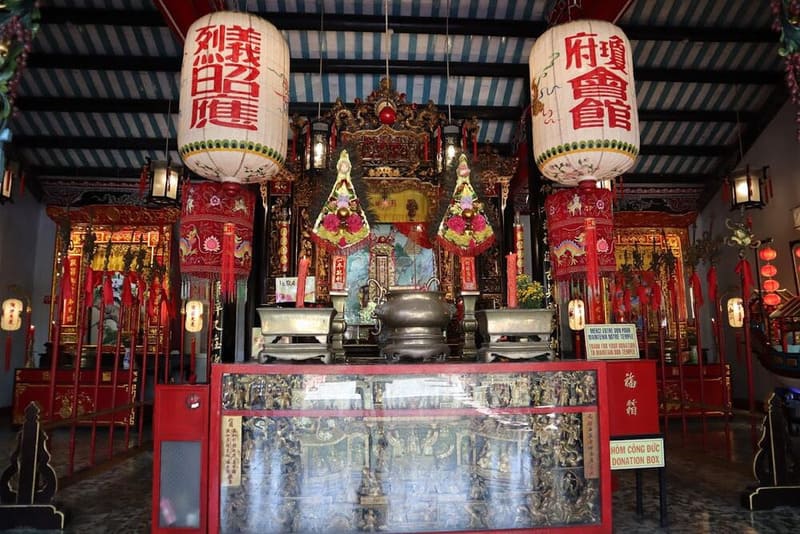
The sacred altar inside Hainan Assembly Hall (Source: Collected)
The intricately carved wooden altar is one of the hall’s most notable artistic features. Its decorative scenes are commonly interpreted as representations of heaven, earth and the underwater world.
Animals, plants, human figures and mythical creatures are carefully integrated into the design, reflecting the craftsmanship of Hoi An’s traditional carpenters, including artisans associated with Kim Bong Carpentry Village.
A red wooden boat displayed inside the worship area symbolizes the maritime roots of the Hainanese community.
It recalls the merchants and sailors who traveled between Hainan, Vietnam and other Southeast Asian ports, while also expressing prayers for protection and safe journeys at sea.
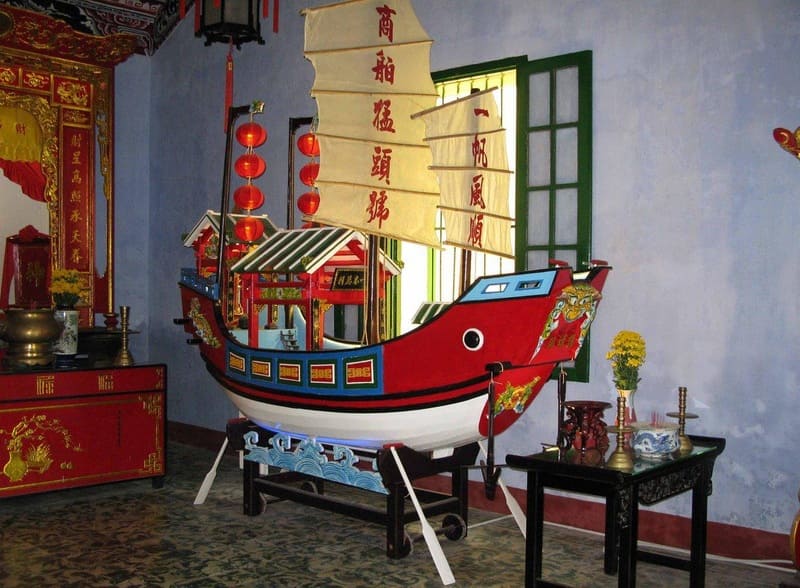
The wooden boat recalls Hainan’s maritime heritage (Source: Collected)
Hainan Assembly Hall is open year-round, but the best experience depends on the season and time of day.
For a complete guide to weather, seasons, festivals, and monthly travel tips, read our best time to visit Hoi An guide before planning your trip.
A few simple tips can help you enjoy a smoother and more respectful visit.
After visiting Hainan Assembly Hall, you can easily explore several other highlights of Hoi An Ancient Town on foot.
The 108 Hainanese Brothers were merchants wrongly executed after being accused of piracy in the 19th century. After an imperial investigation cleared their names, Emperor Tu Duc honored them as righteous martyrs with the title Nghia Liet Chieu Ung. Today, they are worshipped as guardian spirits, and their spirit tablets are enshrined at the main altar of Hainan Assembly Hall.
Hainan Assembly Hall was established in 1875 by Hainanese immigrants, with the main complex completed around 1891. It was restored in 1931 and 1971, then opened to visitors as a heritage attraction in 2016.
Yes. Hainan Assembly Hall is one of the heritage sites included in the Hoi An Ancient Town ticket. International visitors typically pay 120,000 VND, though ticket prices and included attractions may change.
Yes, photography is generally allowed. Avoid using flash near the altars, respect worshippers, and ask permission before photographing ceremonies or religious activities.
Yes. As an active place of worship, visitors should wear modest clothing that covers the shoulders and knees. Remove hats before entering the main sanctuary.
Most visitors spend 20 - 40 minutes exploring the hall. Allow up to 45 minutes if you want to admire the architecture, carvings, and historical displays in more detail.
Whether you spend twenty minutes admiring its architecture or take time to learn the story behind the 108 Hainanese Brothers, Hainan Assembly Hall adds an important historical perspective to any visit to Hoi An. Its peaceful setting and rich heritage make it one of the Old Town's most underrated attractions.


 Vietnam Tours
 Cambodia Tours
 Laos Tours
 Thailand Tours
 Multi-Country Tours