Hidden in a lush valley surrounded by mountains and forest, My Son Sanctuary is one of Vietnam's most important archaeological sites and a UNESCO World Heritage Site. Once the religious and political center of the ancient Champa Kingdom, the sanctuary preserves centuries-old Hindu temples, remarkable brick architecture, and intricate stone carvings that continue to fascinate historians and travelers alike.
My Son Sanctuary is an ancient Hindu temple complex built by the Champa Kingdom between the 4th and 13th centuries. Located in Duy Phu Commune, Duy Xuyen District, Quang Nam Province, the site lies in a peaceful valley about 40 km from Da Nang and 40 - 45 km from Hoi An.
For centuries, My Son served as the spiritual center of the Champa civilization, where kings conducted religious ceremonies, honored Hindu deities, and reinforced their royal authority. Most temples were dedicated to Shiva, one of Hinduism's principal gods, although shrines honoring Vishnu, Brahma, and other deities were also constructed.
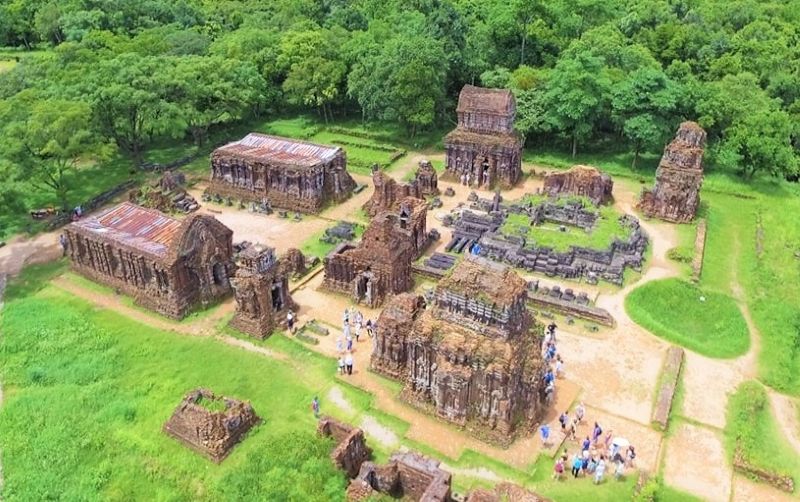
My Son was once the sacred heart of Champa (Source: Collected)
UNESCO recognized My Son Sanctuary as a World Heritage Site in 1999 because of its outstanding cultural and historical value.
The sanctuary represents the architectural and artistic achievements of the Champa Kingdom, which flourished along Vietnam's central coast for more than a thousand years. Although many structures were damaged during wars and natural weathering, the remaining monuments still showcase sophisticated engineering techniques and remarkable craftsmanship.
One of My Son's greatest mysteries is its brick construction. The Cham builders created tightly fitted red brick structures without clearly visible mortar, and researchers continue to study how these temples were assembled. The intricate carvings, sandstone sculptures, and decorative motifs further demonstrate the high level of artistic skill achieved by the Champa civilization.
Construction of My Son Sanctuary began during the reign of King Bhadravarman I in the late 4th century. Over the following centuries, successive Cham rulers expanded the complex by adding new temples, towers, and ceremonial structures.
At its peak, the sanctuary contained more than 70 religious buildings spread across several architectural groups. Each dynasty contributed different construction styles, resulting in a diverse collection of temples that evolved over nearly 900 years.
During the Vietnam War, portions of the sanctuary suffered severe damage, leaving many monuments partially destroyed. Since then, extensive restoration projects led by Vietnamese authorities and international conservation teams have helped preserve many of the surviving structures while protecting the site's archaeological significance.
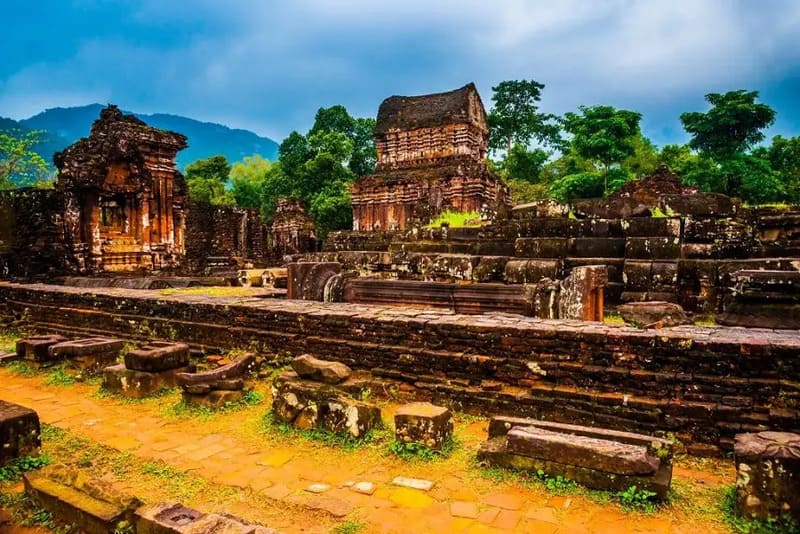
The ruins reflect centuries of Cham history (Source: Collected)
The architecture at My Son Sanctuary is one of the main reasons the site is so valuable. Cham builders used red bricks to construct towers without visible mortar lines, creating structures that have survived for centuries.
Many questions about Cham construction techniques remain unanswered. Researchers have studied how the bricks were fired, how they were bonded, and how decorative carvings were created directly on the brick surfaces. This mystery adds to the appeal of the site.
Common architectural features at My Son include:
The towers were designed for religious worship rather than daily use. Many temples had small interior spaces that housed sacred objects, while the exterior walls carried symbolic carvings and spiritual meanings.
My Son Sanctuary is divided into several temple groups, often identified by letters such as Group A, B, C, D, E, F, G, and H. Some areas are better preserved than others, but each group gives visitors a different view of Cham history and architecture.
The main temple groups are the highlight of My Son. Visitors can walk among brick towers, collapsed walls, restored structures, and carved stone details. Some towers still retain impressive shapes, while others show only foundations or partial walls.
The ruins are especially atmospheric in the early morning, when the site is quieter and the soft light makes the red brick stand out against the surrounding greenery.
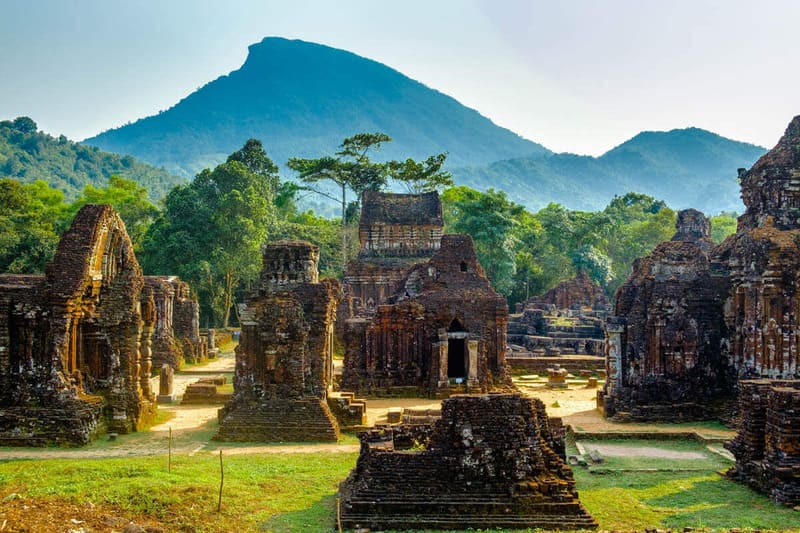
Red brick temple ruins surrounded by forest (Source: Collected)
Many temples at My Son were dedicated to Shiva, and linga-yoni altars were central to worship. The linga represents Shiva, while the yoni symbolizes feminine energy and fertility. Together, they reflect creation, balance, and spiritual power in Hindu belief.
These altars help visitors understand the religious function of the temples and the spiritual importance of the sanctuary.
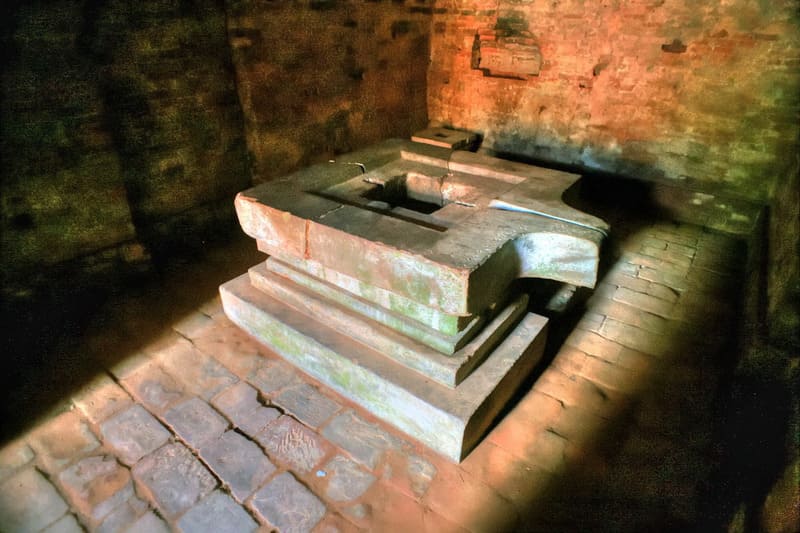
Sacred linga and yoni altars at My Son (Source: Collected)
Although many original artifacts have been moved to museums for preservation, visitors can still see carvings and sculptural details throughout the site. Common motifs include deities, guardians, dancers, animals, lotus patterns, and sacred symbols.
These details show the artistic sophistication of the Cham people and the influence of Indian culture on ancient Central Vietnam.
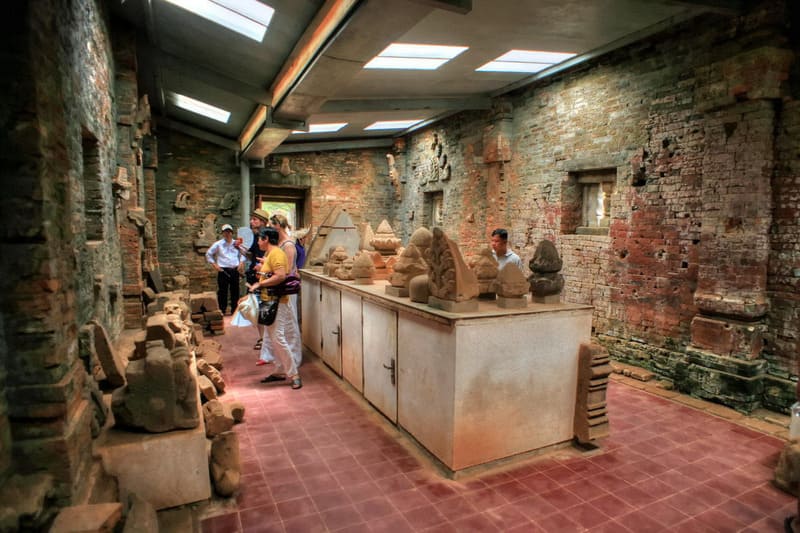
Cham carvings reveal ancient artistry and belief (Source: Collected)
Before or after exploring the ruins, visitors should spend time at the small museum near the entrance. The museum provides useful background on the Champa Kingdom, temple groups, architectural styles, restoration work, and archaeological discoveries.
This stop helps make the visit easier to understand, especially for travelers visiting without a guide.
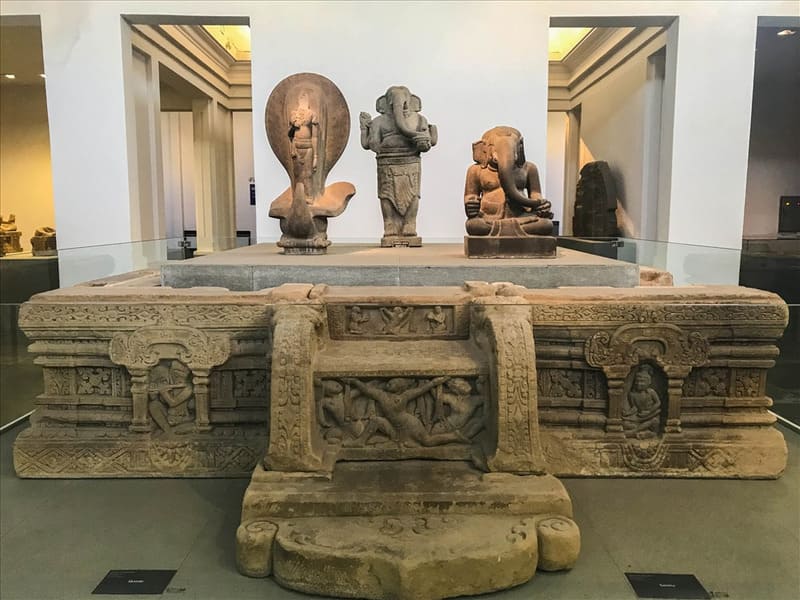
The museum helps explain My Son’s long history (Source: Collected)
My Son Sanctuary also hosts Cham cultural performances at scheduled times during the day. These shows usually include traditional music, dance, costumes, and instruments inspired by Cham heritage.
The performance adds cultural context to the archaeological visit and gives travelers a better sense of the living traditions connected to the site.
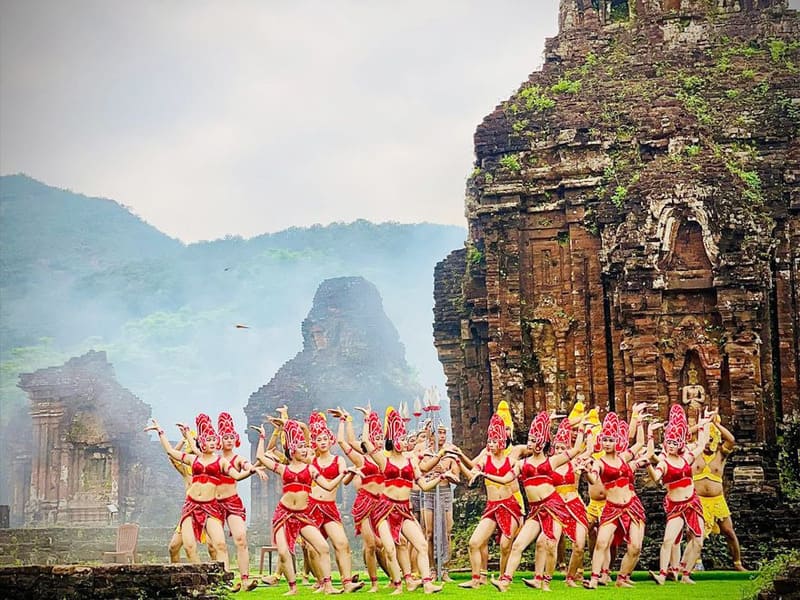
Cham music and dance bring the heritage to life (Source: Collected)
My Son is set in a peaceful valley surrounded by forested hills and mountains. The natural landscape is part of the site’s appeal. The temples were built in a sacred setting, and the surrounding scenery helps visitors understand why this location was chosen for religious worship.
My Son Sanctuary is accessible from Hoi An, Da Nang, and Hue. The best option depends on your budget, schedule, and preferred travel style.
My Son Sanctuary is usually open daily from morning to late afternoon.
Typical visitor information:
Ticket prices and opening hours can change, so travelers should check updated information before visiting. The entrance ticket usually includes access to the archaeological site and a basic site map.
The dry season from February to August offers the most favorable weather for exploring the sanctuary. Sunny skies and lower chances of rain make walking between the temple groups much more comfortable.
For the best overall experience:
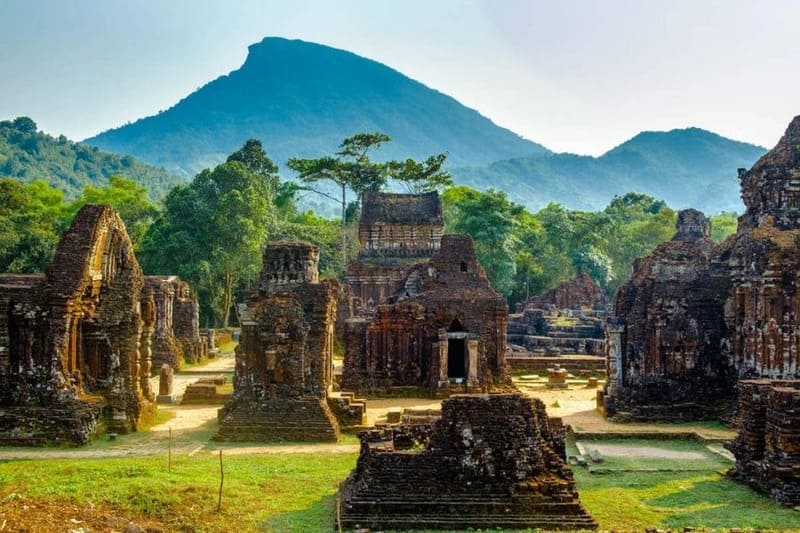
Early morning is the best time to explore My Son (Source: Collected)
Visiting My Son with a guide is strongly recommended if you are interested in history, architecture, or Cham culture. The ruins are impressive on their own, but the site becomes much more meaningful when you understand what the temples were used for, why Shiva worship was important, and how the Cham Kingdom influenced Central Vietnam.
Without a guide, visitors should at least spend time at the museum and read the site map carefully. Audio guides may also be available and can help provide more context during the visit.
To discover more cultural landmarks and must-visit destinations, explore our Central Vietnam travel guide.
A half-day itinerary is enough for most travelers.
Suggested morning plan:
Travelers who enjoy archaeology, photography, or slow cultural travel may want to spend longer at the site.
To make the most of your visit, keep these practical tips in mind:
Most visitors need around 2 to 3 hours to explore My Son Sanctuary. This gives enough time to visit the museum, walk through the main temple groups, take photos, and watch a cultural performance if the timing is suitable.
My Son Sanctuary is slightly closer to Hoi An than Da Nang. From Hoi An, the journey usually takes around 1 to 1.5 hours. From Da Nang, it usually takes around 1.5 hours by car.
Yes, you can visit My Son Sanctuary without a tour by arranging a private car, taxi, motorbike, or shuttle transfer. However, a guide is helpful because the site has deep historical and religious meaning that may not be obvious at first glance.
Early morning (6:00 - 9:00 AM) is the best time to visit My Son Sanctuary. The weather is cooler, the light is better for photos, and the site is usually quieter than later in the day.
Yes, My Son Sanctuary can be suitable for children, especially if the visit is kept short and planned in the morning. Families should bring water, sun protection, snacks, and comfortable shoes.
You should bring water, sunscreen, a hat, insect repellent, comfortable walking shoes, cash, and a camera. During the rainy season, bring a light raincoat or umbrella.
Drone use is usually restricted at heritage sites and protected areas in Vietnam. Visitors should not fly a drone without official permission from the relevant authorities.
Yes. My Son Sanctuary and Hoi An Ancient Town can easily be visited in one day. Spend the morning exploring the temple ruins, then head to Hoi An in the afternoon for sightseeing, local food, and the lantern-lit streets in the evening. The two destinations are about one hour apart by road.
Whether you're fascinated by ancient civilizations, architecture, or Vietnam's cultural heritage, My Son Sanctuary deserves a place on your Central Vietnam itinerary. Arriving early, exploring at a relaxed pace, and learning about the Champa Kingdom will make your visit far more rewarding.


 Vietnam Tours
 Cambodia Tours
 Laos Tours
 Thailand Tours
 Multi-Country Tours