Hidden among the rice terraces of Muong Hoa Valley, Sapa Ancient Rock Field preserves hundreds of ancient stone carvings whose meanings remain largely undeciphered. The site offers a rare blend of archaeology, local culture, and mountain landscapes.
Sapa Ancient Rock Field is located in Muong Hoa Valley, around 8 - 11 kilometers southeast of Sapa town center in Lao Cai Province, northern Vietnam. The carved stones are scattered across the valley area around Hau Thao, Ta Van, Su Pan, and Lao Chai, with many important stones concentrated in Hau Thao Commune.
The site covers about 8 square kilometers, stretching through terraced fields, mountain slopes, streams, and village paths. It sits in one of the most scenic parts of Sapa, surrounded by the Hoang Lien Son Mountain Range, Muong Hoa Stream, rice terraces, and traditional villages of local ethnic communities such as the H’Mong, Giay, and Dao.
The ancient stones are usually described in two main clusters:
Because the rock field is spread across a wide open landscape instead of being placed inside a single fenced attraction, it is best understood as a cultural landscape rather than a simple sightseeing stop. Its value comes from both the carved stones and their natural setting in Muong Hoa Valley.
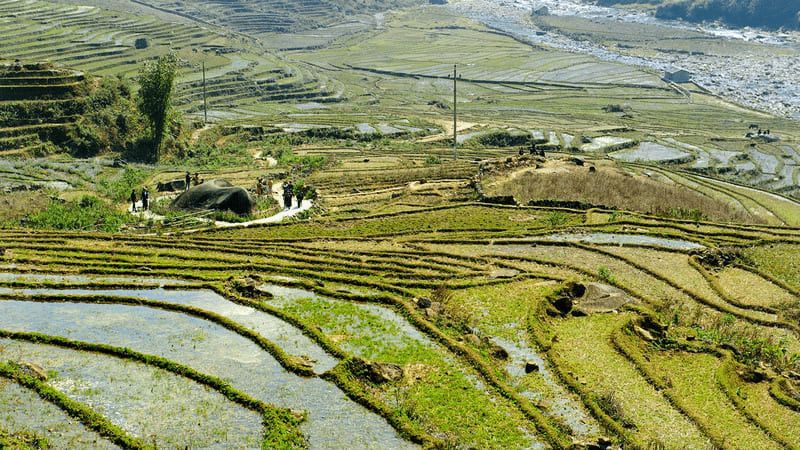
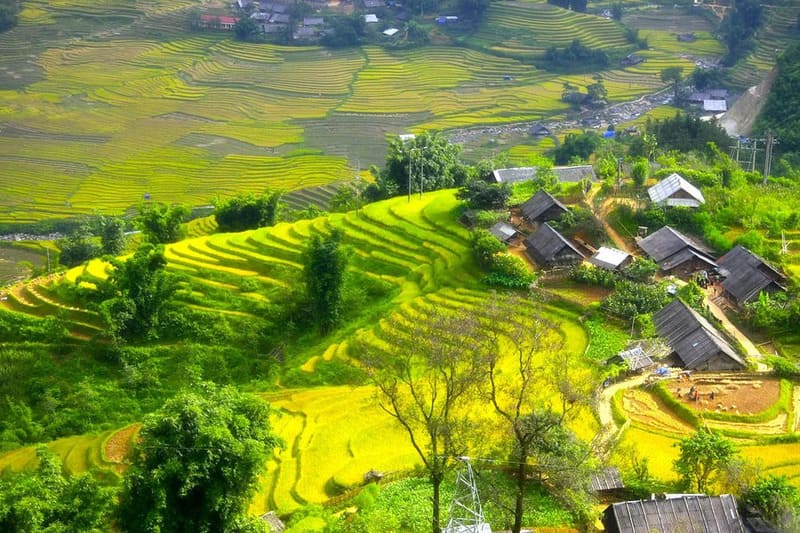
Sapa Ancient Rock Field lies in Muong Hoa Valley (Source: Collected)
Sapa Ancient Rock Field was first studied in 1925 by Victor Goloubew, a French-Russian scholar from the École Française d'Extrême-Orient, also known as EFEO. During early research, about 30 large stones were recorded. Later surveys discovered many more carved stones across Muong Hoa Valley.
In 1994, Sapa Ancient Rock Field was recognized as a National Historical and Cultural Relic. This recognition confirmed its importance as one of Vietnam’s valuable archaeological and cultural heritage sites.
The mystery of the rock field lies in three main questions:
Researchers have proposed different theories, but no final conclusion has been accepted. The carvings may date from different periods, and the stones may have been used for more than one purpose over time.
One theory suggests that the carvings may be linked to ancient communities living in Muong Hoa Valley several centuries ago. Another theory connects some patterns with the Dong Son culture, an important ancient civilization in northern Vietnam. Other researchers believe the carvings may represent early maps, agricultural records, spiritual symbols, astronomical observations, or a form of ancient writing.
Several scholars have tried to interpret the carvings. Victor Goloubew first documented the site in the 1920s. In 1938, anthropologist Paul Lévy compared the Sapa carvings with patterns found in other parts of the world, including Taiwan, Australia, and New Guinea. Later studies continued to record and analyze the stones, but the full meaning remains uncertain.
Some carvings look like stilt houses, terraced fields, human figures, paths, circles, parallel lines, and symbols resembling writing. These images may reflect the daily life, farming practices, beliefs, and worldview of ancient residents in Muong Hoa Valley. However, many patterns remain abstract and difficult to explain.
Local communities also connect the stones with legends. One well-known story tells of “husband stone” and “wife stone,” two stones associated with a tragic love story in Muong Hoa Valley. Other legends describe the carved symbols as protective signs used to drive away danger and bring peace to the villages.
This combination of archaeology, oral tradition, and unexplained symbols makes Sapa Ancient Rock Field one of the most intriguing historical sites in Vietnam.
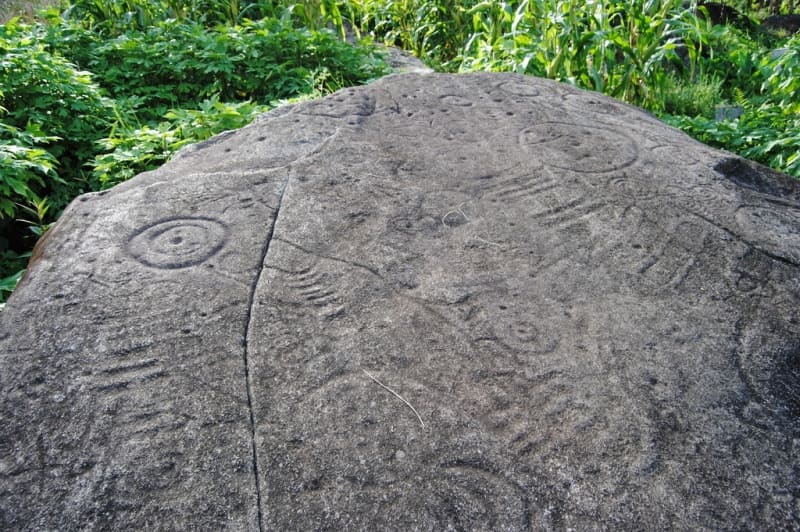
Mysterious carvings make the rock field fascinating (Source: Collected)
The main highlight of Sapa Ancient Rock Field is its collection of mysterious rock carvings. Instead of being decorative stones placed for tourism, these are ancient stone blocks scattered naturally across hillsides, fields, and streams. Many carvings are deeply engraved into the stone surface, while others have become faint due to time, weather, and human impact.
One of the most interesting features is the variety of patterns. Visitors and researchers have identified parallel lines, geometric shapes, spirals, circles, human-like figures, stilt houses, terraced fields, roads, fertility symbols, and marks that resemble ancient characters. These carvings give the impression of a visual record, but the language or system behind them has not been fully decoded.
The rock field is also valuable because of its setting. The stones are surrounded by terraced rice fields, Muong Hoa Stream, bamboo groves, and mountain villages. During the rice season, the ancient stones appear among green or golden terraces, creating a rare landscape where archaeology and nature blend together.
Another highlight is the cultural atmosphere of Muong Hoa Valley. The surrounding area is home to H’Mong, Giay, and Dao communities. Local villages, traditional houses, farming activities, and mountain paths give visitors a better sense of how people have lived in this valley for generations.
The site also has strong conservation value. Many carvings have been affected by weathering, moss, erosion, and tourist behavior. For this reason, preservation work is important to protect the stones for future research and cultural education. Travelers should avoid touching, climbing, scratching, or writing on the stones if access is allowed again.
A visit to the Sapa Ancient Rock Field area is not just about seeing ancient stones. It is about understanding a rare cultural landscape that connects nature, local communities, archaeology, and unanswered historical questions.
The best time to visit Sapa Ancient Rock Field is from September to October, when Muong Hoa Valley enters the golden rice season. The terraced fields turn bright yellow before harvest, creating a beautiful backdrop for the ancient stones, mountain views, photography, and trekking.
For the best experience, visit in the morning or late afternoon. Morning offers soft light, mist, and a peaceful atmosphere, while late afternoon is ideal for photography, especially during rice season.
To plan your trip around Sapa's changing seasons, explore our guide to the best time to visit Sapa.
Sapa Ancient Rock Field lies about 8 - 11 kilometers southeast of Sapa town, in the Muong Hoa Valley area. The usual route follows Muong Hoa Road and Provincial Road 152, passing rice terraces and ethnic villages.
You can reach the site in several ways:
From Hanoi, first travel to Sapa by sleeper bus, limousine bus, train to Lao Cai followed by a transfer, or private car, then continue to the rock field from Sapa town.
Because access conditions may change due to conservation work, it is advisable to check with your hotel, tour operator, or local tourism office before visiting.
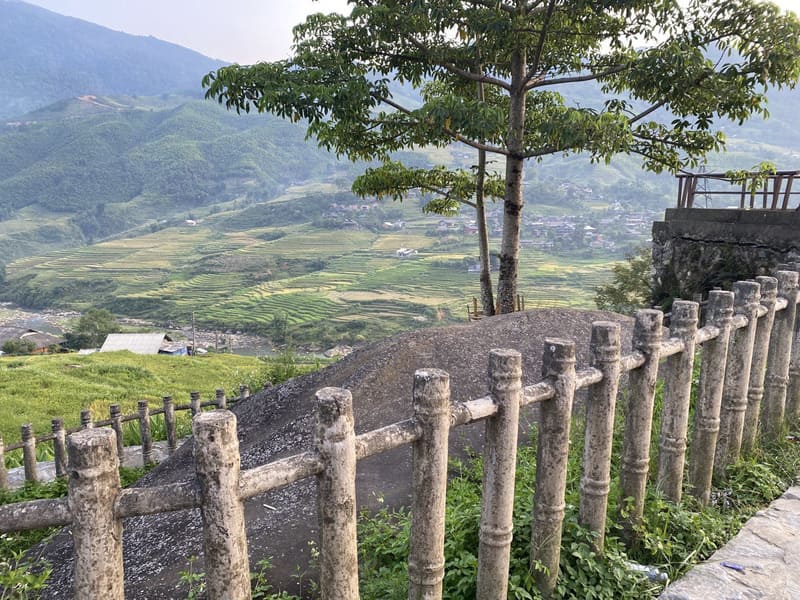
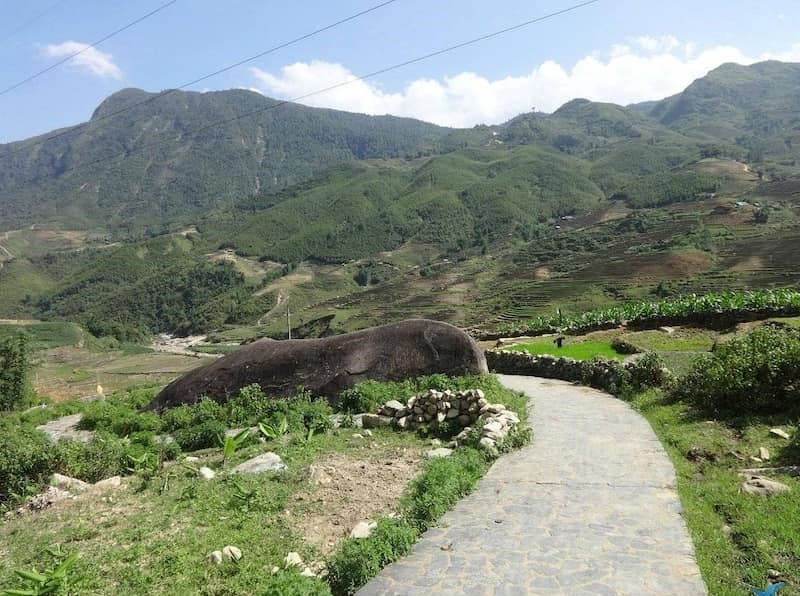
The road to Sapa Ancient Rock Field is easy to follow (Source: Collected)
There are no major dining areas inside Sapa Ancient Rock Field, but you can find local food in nearby villages, homestays, cafes, and restaurants around Muong Hoa Valley, Ta Van, Lao Chai, and Sapa town.
Before visiting Sapa Ancient Rock Field, keep these practical tips in mind to protect the site, plan your route better, and make the experience more meaningful.
It is famous for hundreds of ancient carvings etched into large stones across Muong Hoa Valley. The symbols, figures, and patterns remain largely undeciphered, making the site one of Sapa’s most intriguing archaeological landmarks.
Most visitors spend 1 - 2 hours at the site. If combined with Lao Chai, Ta Van, or other Muong Hoa Valley attractions, a half-day trip is ideal.
Yes, but a local guide can provide historical context, explain local legends, and help you navigate access restrictions that may apply in some areas.
Their meaning is still unknown. Researchers believe they may represent village maps, agricultural records, spiritual symbols, or an ancient form of communication.
Yes, if visiting by car and avoiding long treks. Some paths can be steep or muddy, especially during the rainy season.
Yes. Many travelers combine it with Lao Chai Village, Ta Van Village, Muong Hoa Stream, Cau May Bridge, and the surrounding rice terraces.
Sapa Ancient Rock Field offers a unique blend of archaeology, local culture, and mountain scenery. While the meaning of its carvings remains a mystery, the site provides a fascinating glimpse into the region’s ancient past. For the best experience, combine your visit with nearby villages and attractions in Muong Hoa Valley.


 Vietnam Tours
 Cambodia Tours
 Laos Tours
 Thailand Tours
 Multi-Country Tours